

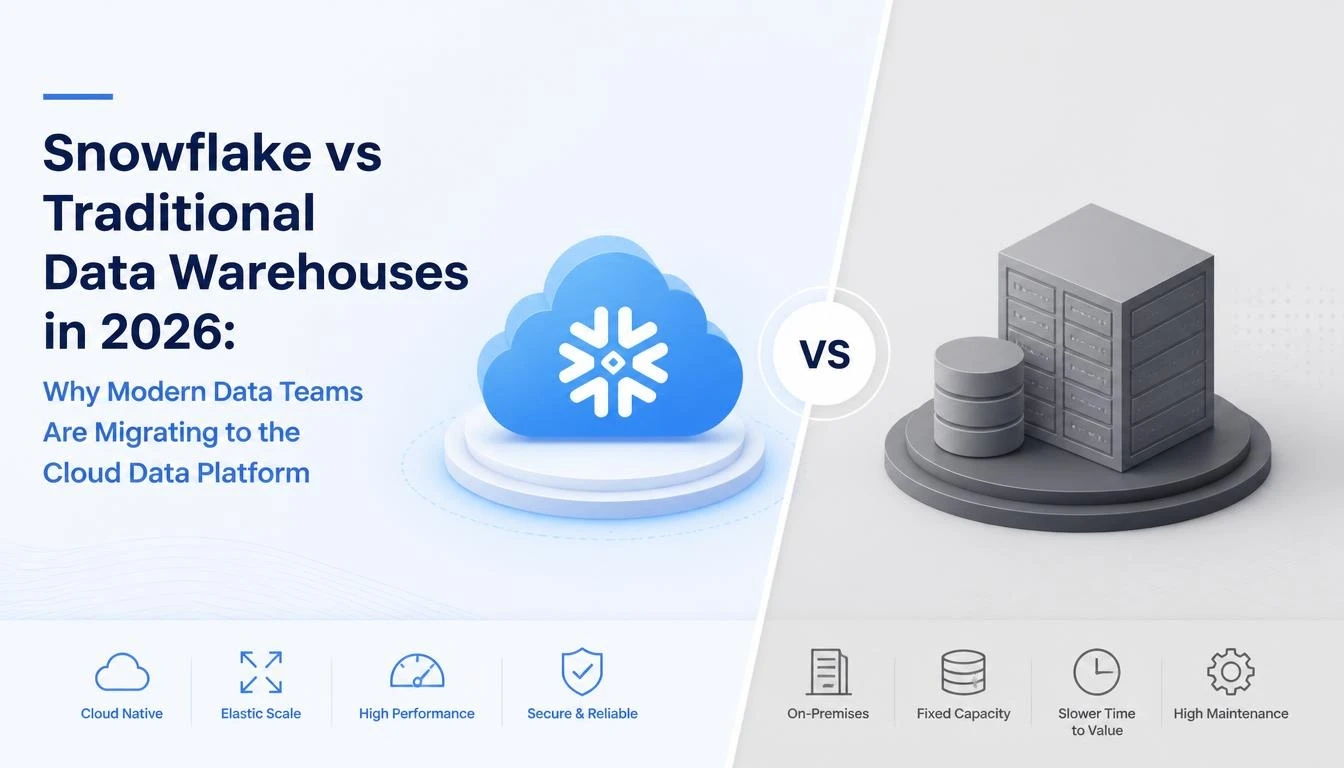
1. The Fundamental Architectural Divide: Coupled Systems vs. Decoupled Cloud-Native Platforms
To understand why modern data engineering teams are aggressively migrating away from traditional enterprise data warehouses, one must first examine the physical and logical constraints of traditional on-premises appliances. Systems such as Teradata, Oracle Exadata, and legacy on-premises MPP stacks were built upon a 'Shared-Nothing' architecture. In this paradigm, a physical server node houses its own private CPU processors, local RAM memory, and dedicated physical hard drives. When an analytical query runs, each node processes only the subset of data stored on its internal disks, passing intermediate results across a proprietary high-speed backplane interconnect.
While shared-nothing architectures were revolutionary in the late 1990s and 2000s, they impose a severe operational penalty: rigid coupling of compute and storage. If an enterprise's analytical data volume grows from 50 terabytes to 300 terabytes, the organization is legally and physically forced to purchase additional hardware nodes. Each node purchase includes expensive multi-core enterprise CPUs and RAM modules—even if existing compute capacity is sitting 85% idle during normal business hours. Conversely, if a business experiences a surge in analytical query complexity (such as high-frequency risk simulations or end-of-month financial reconciliation) requiring 10x more processing power, it cannot scale compute independently without provisioning duplicate physical storage arrays.
The Snowflake Three-Tier Decoupled Architecture
Snowflake fundamentally discarded the shared-nothing model by inventing a three-tier architecture that completely separates storage, compute, and centralized global cloud management services:
• 1. Centralized Cloud Database Storage Tier: All ingested data (structured and semi-structured) is stored in cost-effective, infinitely scalable cloud object stores (Amazon S3, Google Cloud Storage, or Microsoft Azure Blob Storage). Data is automatically encrypted with AES-256, compressed, columnar-organized, and divided into immutable, optimized files called micro-partitions. Because storage is decoupled from compute, enterprises pay only for the raw compressed gigabytes stored on disk, with near-zero overhead.
• 2. Multi-Cluster Virtual Compute Warehouse Tier: Compute processing is handled by independent virtual clusters called Virtual Warehouses. Each virtual warehouse is an isolated cluster of CPU and memory nodes provisioned in seconds. Because compute clusters read directly from the shared storage tier without sharing CPU or RAM, multiple virtual warehouses can query the exact same underlying datasets simultaneously with zero resource contention.
• 3. Cloud Services Coordination Tier: Operating on serverless infrastructure, the Cloud Services tier acts as the brain of the platform. It coordinates client authentication, role-based access control (RBAC), ACID transaction locks, query parsing, cost-based query optimization, metadata management, and automated partition pruning.
- Shared-Nothing Coupling: Forces expensive hardware expansions where storage and compute cannot scale independently.
- Decoupled Elasticity: Snowflake allows storage to grow to petabytes while compute scales up, scales out, or completely suspends automatically.
- Zero Resource Contention: Data transformation (ETL) jobs run on isolated compute clusters without slowing down executive BI reporting dashboards.
2. Concurrency, Workload Isolation & The Elimination of Batch Windows
In a traditional on-premises data warehouse environment, resource contention is an everyday crisis for Data Platform Engineers. Consider a common enterprise scenario: at 8:00 AM every business day, hundreds of business analysts across finance, sales, and supply chain log into Tableau or Power BI to execute aggregate dashboard queries. Simultaneously, the overnight batch ETL pipeline—responsible for transforming millions of raw ERP transactions—has overrun its scheduled window due to unexpected data volume spikes.
In legacy coupled architectures, both the heavy ETL merge queries and the interactive business analyst dashboard queries compete for the exact same CPU cores, memory registers, and disk I/O channels. The result is catastrophic: table locks, query timeouts, memory spills, and frustrated stakeholders waiting 15 minutes for a single quarterly sales chart to render. Enterprise DBAs spend hundreds of hours manually tuning priority queues, killing ad-hoc user queries, and managing complex workload management (WLM) rule matrices.
Workload Isolation in Action: Dedicated Virtual Warehouses
Snowflake completely eliminates resource contention through workload isolation. Because virtual warehouses are logically isolated compute clusters operating over a shared storage layer, data platform architects can assign dedicated, right-sized compute resources to specific business workloads:
• ETL / Data Engineering Warehouse (Size: Large, 8 nodes): Spins up automatically at 2:00 AM to process high-throughput transformations, execute dbt models, and merge records into production fact tables, then shuts down instantly upon completion.
• BI Reporting Warehouse (Size: Medium, Multi-Cluster 1-4 nodes): Configured with horizontal auto-scaling (SCALING_POLICY = 'STANDARD'). When 500 analysts log in on Monday morning, Snowflake automatically spins up identical compute clusters in parallel to handle the concurrent query queue, scaling back down to a single cluster as traffic subsides.
• Data Science & Ad-Hoc Sandbox Warehouse (Size: X-Large, 16 nodes): Data scientists train complex machine learning models or execute ad-hoc statistical queries without ever degrading the performance of customer-facing dashboards or mission-critical ingestion pipelines.
Because each virtual warehouse operates in complete compute isolation, a long-running, poorly written ad-hoc analytical query executed by an analyst will never starve or slow down the core transactional data pipelines.
- Multi-Cluster Auto-Scaling: Automatically adds and removes secondary compute clusters based on live query concurrency spikes.
- Independent Workload Allocation: Isolates Finance, Marketing, Data Science, and Core Ingestion into separate compute billing entities.
- Zero Operational Lockouts: Eliminates the concept of 'batch maintenance windows'—data pipelines run continuously 24/7/365.
3. Micro-Partitioning & Pruning vs. Legacy Manual Indexing & Maintenance
Database administrators (DBAs) managing legacy relational data warehouses like Oracle, Microsoft SQL Server, or PostgreSQL spend substantial portions of their careers managing indexes. In traditional systems, achieving acceptable query response times across multi-billion-row tables requires manual planning: creating clustered B-Tree indexes, designing non-clustered composite indexes, configuring table partitions across date boundaries, defragmenting fragmented tables, and manually executing database statistics updates (ANALYZE TABLE).
As data volumes scale into terabytes, physical indexing breaks down. Maintaining indexes on high-throughput tables causes write amplification: every single INSERT, UPDATE, or DELETE statement requires the database engine to synchronously traverse and rewrite the B-Tree index structure on disk, causing lock escalation and degrading ingestion throughput. Furthermore, if a business query filters on a column that is not part of the primary index, the database engine falls back to an expensive sequential table scan.
How Snowflake's Immutable Micro-Partitioning Works
Snowflake completely eradicates physical B-Tree indexes, vacuuming, and manual partitioning. Instead, Snowflake automatically organizes all data inserted into tables into micro-partitions:
• Natural Size Boundaries: Micro-partitions are contiguous units of storage containing between 50 MB and 500 MB of uncompressed data (typically compressed down to 10 MB to 50 MB on disk).
• PAX Hybrid Columnar Storage: Within each micro-partition, data is stored in a columnar format. When an analytical query runs SELECT customer_id, SUM(order_amount) FROM fact_orders, Snowflake's execution engine reads only the specific bytes corresponding to customer_id and order_amount, completely bypassing unused columns.
• Automated Metadata Capture: During data ingestion, Snowflake's Cloud Services layer automatically extracts and records granular metadata for every column in every micro-partition: the minimum value, maximum value, total null count, and distinct value cardinality.
• Zero-Overhead Partition Pruning: When an analytical query arrives with a filter predicate (e.g., WHERE order_date BETWEEN '2026-06-01' AND '2026-06-07'), the query optimizer evaluates the metadata catalog before reading a single byte from storage. If a micro-partition's metadata indicates min_date = '2026-01-01' and max_date = '2026-01-15', Snowflake prunes (skips) that partition entirely. On a 10,000-partition table, Snowflake can prune 9,980 partitions in milliseconds, reading only the 20 partitions containing relevant data blocks from cloud storage.
- Zero Index Maintenance: No B-Trees, no index rebuilds, and no vacuuming operations required.
- Automated Metadata-Driven Pruning: Eliminates full table scans without requiring explicit manual partition keys.
- Immutability & High-Speed Ingestion: Ingestion operations never lock tables or rebuild index trees, maintaining continuous high write throughput.
4. Continuous Ingestion & Modern ELT: Snowpipe vs. Legacy Batch Loading
Traditional data warehouse workflows depend heavily on Extract, Transform, Load (ETL) architectures managed by legacy middleware (Informatica PowerCenter, IBM InfoSphere DataStage, SSIS). In this legacy workflow, heavy data processing engines extract data from transactional databases, transform and normalize records in intermediate staging memory on separate physical servers, and bulk-load finished datasets into the data warehouse during overnight batch cycles.
This legacy approach introduces severe business limitations: data in reporting dashboards is perpetually 24 hours out of date, intermediate ETL servers represent a single point of hardware failure, and unexpected schema changes in source databases break brittle transformation scripts, causing entire nightly batches to abort.
The Modern ELT Paradigm with Serverless Snowpipe
Modern cloud engineering inverts this process into Extract, Load, Transform (ELT). Raw data is ingested directly into Snowflake as fast as it is produced, leveraging the massive parallel compute power of the cloud data warehouse to execute transformations directly inside the platform:
• Serverless Event-Driven Snowpipe: Instead of spinning up virtual warehouses to execute scheduled COPY INTO commands on an hourly loop, Snowpipe operates completely serverless. When source systems, IoT gateways, or microservices drop raw JSON, CSV, or Parquet files into cloud storage buckets (AWS S3, Azure Blob, or Google Cloud Storage), cloud storage event notifications (e.g., S3 s3:ObjectCreated:* via SQS/SNS) alert Snowpipe instantly. Snowpipe allocates serverless micro-compute resources to ingest and compress the records into landing tables in near-real-time—with zero manual cluster management.
• Native Semi-Structured Variant Support: In traditional relational databases, ingesting semi-structured nested JSON, Avro, or Parquet logs requires developers to pre-define rigid database schemas and write complex extraction logic. Snowflake features a native VARIANT data type that stores raw JSON up to 16 MB per record, maintaining sub-column columnar compression while allowing data engineers to query nested attributes using intuitive SQL dot and bracket notation:
``sql``
-- Querying Raw Semi-Structured JSON Directly in Snowflake SQL
SELECT
raw_payload:event_id::VARCHAR AS event_id,
raw_payload:customer.email::VARCHAR AS customer_email,
item.value:sku::VARCHAR AS product_sku,
item.value:price::FLOAT AS unit_price
FROM raw_web_events,
LATERAL FLATTEN(input => raw_payload:cart_items) item;
• Change Data Capture (CDC) via Streams and Tasks: Once raw records land in staging tables, Snowflake Streams record change data capture (CDC) deltas (inserts, updates, deletes) with zero table locking. Automated, CRON-scheduled Snowflake Tasks then execute downstream SQL merges, keeping production dimensional models synchronized with sub-minute latency.
- Serverless Continuous Ingestion: Ingest streaming files continuously without paying for idle, running virtual warehouses.
- Native VARIANT Data Type: Ingest schema-less JSON, Parquet, and XML without upfront DDL schema definitions.
- In-Database ELT Orchestration: Transform data directly within Snowflake using Streams, Tasks, and dbt rather than external ETL server clusters.
5. Zero-Copy Cloning, Time Travel & Disaster Recovery Mechanics
In legacy database administration, provisioning isolated environments for development, testing, quality assurance, or machine learning experimentation is one of the most painful operational exercises. If an enterprise data warehouse contains 20 terabytes of production data, copying that dataset into a staging environment requires:
1. Provisioning an identical 20 terabyte secondary storage disk array.
2. Initiating a multi-hour network data export/import job that saturates network bandwidth.
3. Paying 2x the software licensing and physical disk storage costs for every additional environment.
Because of these constraints, QA teams in traditional environments are forced to test database migrations and analytical models against tiny, out-of-date data samples, resulting in frequent production bugs when code is deployed against full-scale datasets.
Zero-Copy Cloning: Instant Sandboxes with Zero Storage Overhead
Snowflake completely solves this bottleneck through Zero-Copy Cloning. Because micro-partitions stored in cloud storage are immutable, cloning a table, an entire schema, or a multi-terabyte production database creates only a new metadata pointer referencing the existing physical micro-partitions in the metadata catalog:
• Instant Execution: Executing CREATE DATABASE staging_dw CLONE production_dw; takes under 5 seconds, regardless of whether the database contains 10 gigabytes or 500 terabytes.
• Zero Additional Storage Cost: Because no physical data bytes are copied, the newly created staging environment incurs $0 in immediate storage costs.
• Copy-on-Write Semantics: As developers or QA automated test suites modify, insert, or delete records within the cloned sandbox, Snowflake writes only the newly modified micro-partitions to disk. Unchanged historical data continues to be shared between both environments, completely isolating production from development experiments.
Continuous Data Protection: Time Travel & Fail-Safe
In traditional databases, recovering from an accidental DROP TABLE or an erroneous UPDATE statement that overwrote millions of records requires restoring massive backup tapes from previous nights, causing hours or days of operational downtime. Snowflake provides built-in continuous data protection:
• Time Travel: Allows data engineers to query, restore, or clone historical data from any specific second, timestamp, or statement ID up to 90 days in the past (Enterprise Edition):
``sql``
-- Restoring Accidental Overwrites Using Snowflake Time Travel
CREATE OR REPLACE TABLE dim_customers AS
SELECT * FROM dim_customers BEFORE (STATEMENT => '01b4e28a-0001-2a3b-0000-00012a4b89cd');
-- Instantly Undrop Dropped Tables with Zero Data Loss
UNDROP TABLE fact_financial_ledger;
• Fail-Safe Disaster Recovery: If the Time Travel retention period expires, data automatically enters a non-configurable 7-day Fail-Safe window managed exclusively by Snowflake Operations, protecting enterprises against catastrophic physical disaster recovery events.
- Zero-Copy Cloning: Create full-scale production replicas for QA and ML in seconds with $0 initial storage overhead.
- Point-in-Time Time Travel: Query historical snapshots or recover from accidental drops without tape restores.
- Immutable Auditability: Preserves historical states for compliance, financial audits, and regulatory forensic investigations.
6. FinOps & Cost Engineering: Traditional Licensing vs. Per-Second Cloud Metering
The economic model of data warehousing has undergone a complete transformation. Traditional on-premises systems follow a high-risk Capital Expenditure (CapEx) model. Purchasing an enterprise Teradata or Exadata rack requires multi-million-dollar upfront commitments covering hardware appliances, proprietary storage controllers, expensive enterprise software core licenses, annual support contracts (typically 18-22% of license cost annually), and data center operational overhead (power, cooling, rack space, dedicated systems administrators).
Because hardware cycles last 3 to 5 years, IT leaders are forced to over-provision capacity for hypothetical future peak workloads. A cluster sized to handle peak black-Friday transaction spikes sits 80% idle for 11 months of the year, burning millions of dollars in amortized capital cost.
Snowflake's Operational Expenditure (OpEx) Model
Snowflake operates on an elastic Operational Expenditure (OpEx) consumption model:
• Decoupled Billing: Storage is billed at standard cloud object rates (~23 to 40 per compressed TB per month). Compute is billed separately in Snowflake Credits, metered down to the exact second with a 60-second minimum.
• Auto-Suspend & Auto-Resume: Virtual compute warehouses can be configured to suspend automatically after a designated period of inactivity (e.g., AUTO_SUSPEND = 60 seconds). The moment a business analyst runs a query or a pipeline drops a file, the warehouse wakes up instantly, executes the query, and shuts back down. If no queries run between 11:00 PM and 5:00 AM, the enterprise incurs $0 in compute costs during those hours.
• Resource Monitors for Hard Budget Governance: To prevent runaway queries or developer testing mistakes from inflating cloud bills, Snowflake allows platform leaders to configure Resource Monitors that trigger alerts at threshold percentages (80%, 90%) and automatically suspend compute clusters upon reaching 100% of the allocated monthly budget.
- Per-Second Metering: Pay only for the exact seconds compute clusters are actively processing queries.
- Auto-Suspend Savings: Eliminates paying for idle CPU/RAM overnight or during low-traffic operational windows.
- Budget Guardrails: Enforce hard account-level and warehouse-level spend limits via automated Resource Monitors.
7. Head-to-Head Comparison: Traditional Data Warehouses vs. Snowflake in 2026
To provide a clear, definitive comparison for enterprise architects, CTOs, and data engineering leaders evaluating modernization roadmaps, the following matrix contrasts traditional data warehouses with Snowflake across core architectural, operational, and financial dimensions:
- Architecture Paradigm: Traditional systems couple compute and storage in rigid shared-nothing nodes; Snowflake decouples centralized cloud storage, multi-cluster virtual compute, and serverless cloud services.
- Scaling Mechanism: Traditional systems require physical hardware provisioning and complex cluster re-sharding; Snowflake enables sub-second vertical scale-up (T-shirt sizing) and horizontal multi-cluster auto-scaling.
- Concurrency Handling: Traditional systems suffer from resource contention, table locking, and query queues during peak hours; Snowflake provides complete workload isolation via independent virtual warehouses with zero query degradation.
- Maintenance & Tuning: Traditional systems demand manual B-tree indexing, partition defragmentation, and vacuuming; Snowflake automates micro-partitioning, metadata-driven pruning, and eliminates physical indexing.
- Data Ingestion: Traditional systems rely on rigid nightly batch ETL windows; Snowflake supports continuous, serverless event-driven ingestion via Snowpipe and Change Data Capture via Streams and Tasks.
- Semi-Structured Data: Traditional systems require rigid schema-on-write transformations before ingestion; Snowflake natively stores and queries nested JSON, Parquet, and XML using the first-class VARIANT type.
- Environment Provisioning: Traditional systems require days and 2x physical disk costs to replicate datasets for QA; Snowflake delivers instant Zero-Copy Cloning with zero initial storage duplication.
- Disaster Recovery: Traditional systems require complex tape backup restorations; Snowflake features continuous Time Travel up to 90 days and automated 7-day Fail-Safe disaster recovery.
- Cost Structure: Traditional systems mandate multi-million-dollar upfront CapEx hardware and core licenses; Snowflake meters compute per second with automated auto-suspend policies and FinOps resource monitors.
8. The 2026 Migration Playbook: How Modern Data Teams Transition to Snowflake
Migrating an enterprise from a legacy on-premises data warehouse (Teradata, Oracle, Netezza) to Snowflake is a strategic engineering initiative that requires a phased modernization playbook rather than a rushed 'lift-and-shift':
Phase 1: Assessment, Cataloging & Workload Profiling
The migration begins with an exhaustive audit of existing legacy data assets: cataloging tables, views, stored procedures, scheduled cron jobs, and downstream BI reports. Enterprise tools like Snowflake Horizon or automated migration analyzers profile query histories to categorize workloads into high-priority daily production pipelines, historical archive datasets, and deprecated tables that can be retired.
Phase 2: Dual-Ingestion & Data Lake Landing
To ensure zero downtime for business operations, teams implement dual-ingestion pipelines. Raw operational data from source databases (Postgres, Oracle OLTP) is mirrored to cloud storage buckets (AWS S3) using CDC tools (Fivetran, Qlik, Debezium). Historical data is extracted into compressed Parquet files and uploaded to external stages in Snowflake.
Phase 3: Schema Modernization & dbt ELT Refactoring
Rather than copying procedural, 2,000-line legacy stored procedures containing nested cursors and temporary tables, modern teams refactor business logic into clean, modular SQL models using dbt (data build tool). Staging models clean raw inputs, intermediate models handle business joins, and marts materialize production Kimball star schemas with automated data assertion tests.
Phase 4: Parallel Validation & Cutover
During the validation phase, both legacy data warehouses and Snowflake run in parallel. Automated reconciliation scripts compare query results, record counts, financial balances, and dashboard metrics across both platforms to guarantee 100% data fidelity. Once stakeholders sign off on performance and accuracy, downstream BI tools (Power BI, Tableau) are re-pointed to Snowflake virtual warehouses, and legacy hardware appliances are safely decommissioned.
- Phased Modernization: Avoid risky lift-and-shift migrations by auditing, profiling, and migrating workloads in prioritized sprints.
- Dual-Ingestion Architecture: Run cloud data pipelines in parallel with legacy systems to guarantee uninterrupted business operations.
- Refactoring to Modern ELT: Replace brittle legacy stored procedures with modular, version-controlled dbt models and automated data testing.
- Comprehensive Reconciliation: Use automated testing scripts to validate data fidelity before executing final reporting cutover.
Explore Local IT Training Programs
Top-rated job-oriented training & internships in Coimbatore & Chennai