

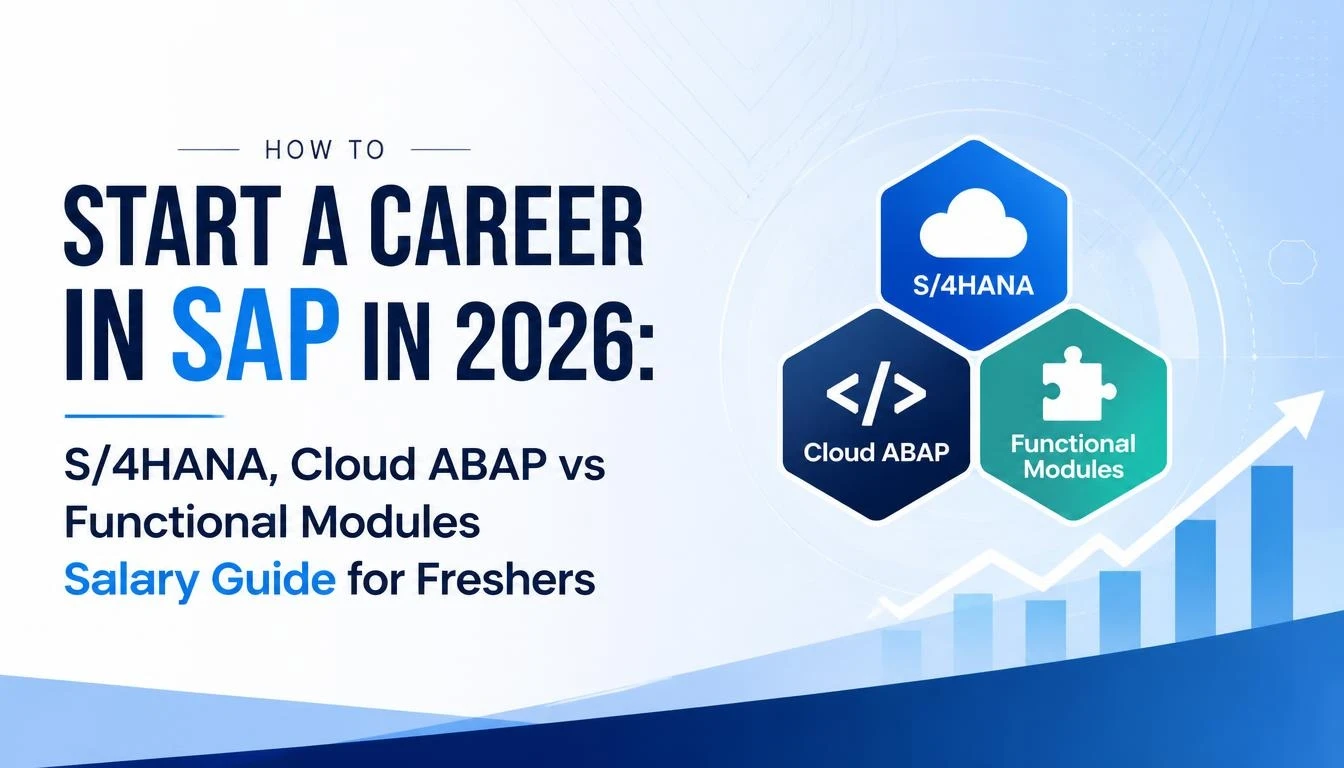
The 2026 SAP Revolution: Why S/4HANA Cloud and 'Clean Core' Changed Everything
To build a successful career in SAP, you must understand the historic inflection point reshaping the entire enterprise software industry. For more than two decades, the backbone of global enterprise IT was SAP ECC 6.0 (ERP Central Component). In traditional ECC implementations, companies had unrestricted access to the underlying database and application layers. When an enterprise needed custom functionality, developers wrote custom ABAP code (commonly called 'Z-programs' or 'User Exits') that directly altered core tables and hooked deeply into standard business logic.
While this custom flexibility seemed convenient initially, it created a technical nightmare known as 'Spaghetti ERP'. Over ten or fifteen years, enterprise codebases accumulated hundreds of thousands of lines of unmaintainable, custom modifications. Upgrades became monumental multi-year engineering projects costing tens of millions of dollars because every software patch broke hundreds of custom scripts.
To permanently eradicate this architectural liability, SAP introduced SAP S/4HANA Cloud running on the revolutionary in-memory SAP HANA database, backed by an uncompromising operational mandate: The 'Clean Core' Architecture.
Under Clean Core, the central ERP kernel remains pristine and untouched. No developer is permitted to directly modify standard SAP tables or write unmanaged database triggers. Instead, all enterprise customizations, workflow automation, and extensions must be engineered either through strictly managed On-Stack Developer Extensibility (using ABAP Cloud, Core Data Services, and the RESTful Application Programming Model - RAP) or through Side-by-Side Extensibility on the SAP Business Technology Platform (SAP BTP).
Because millions of global corporations face SAP's hard deadline to sunset legacy ECC installations, there is an acute, critical shortage of modern SAP developers and consultants who understand modern S/4HANA paradigms. Freshers entering the industry in 2026 who master modern Clean Core standards possess an immense structural advantage over legacy consultants stuck in 1990s procedural ABAP.
- Legacy SAP ECC systems allowed uncontrolled custom code ('Z-developments') that made system upgrades prohibitive.
- SAP S/4HANA enforces 'Clean Core': standard core code remains untouched, while customizations live in managed extension layers.
- Custom development now mandates modern ABAP Cloud, Core Data Services (CDS Views), and the RESTful Application Programming Model (RAP).
- Thousands of enterprises are racing to complete S/4HANA cloud migrations, triggering soaring demand and premium salary packages for fresh talent.
The Great Divide: Technical (ABAP Cloud / RAP) vs Functional Modules (FICO, MM, SD)
When entering the SAP world, the first and most critical decision every aspirant must make is choosing between the Technical Track and the Functional Track. Confusing these two pathways is the primary reason why many graduates struggle to clear interviews.
The Technical Track: SAP S/4HANA ABAP Cloud & BTP Developer
If you have a background in Computer Science, IT, MCA, or simply love programming, software algorithms, and database architecture, the Technical Track is your ideal home. A modern Technical Consultant does not sit in user meetings debating financial policies; you are a software engineer building mission-critical enterprise applications.
In modern S/4HANA, an ABAP developer's day-to-day responsibilities include: modeling high-performance virtual data models using Core Data Services (CDS Views) directly within the SAP HANA in-memory database, building enterprise transactional business objects using ABAP RAP, writing managed business logic behaviors (determinations, validations, actions), creating OData v4 web services, and building modern, responsive browser frontends using SAP Fiori / SAPUI5.
The Functional Track: Business Process Consulting (FICO, MM, SD, PP)
If you come from a non-CS engineering branch (Mechanical, Civil, Industrial), a Commerce background (B.Com, M.Com, CA-Inter), or possess an MBA in Finance or Operations, the Functional Track offers an extraordinary career runway. Functional Consultants are the translators who bridge corporate business realities with SAP system configuration.
A Functional Consultant rarely writes raw lines of code. Instead, you configure the system via SAP's configuration back-office (SPRO / Implementation Guide). You conduct workshops with corporate business stakeholders—such as Chief Financial Officers, Warehouse Managers, or VP of Sales—to analyze how the enterprise purchases raw goods, reconciles general ledgers, or invoices customers.
The primary functional specializations include: SAP FICO (Financial Accounting & Management Controlling), SAP MM (Materials Management & Procurement), SAP SD (Sales & Distribution), and SAP PP (Production Planning).
- Technical Track: Focuses on software engineering, database modeling (CDS), enterprise APIs (OData), and transactional frameworks (ABAP RAP).
- Functional Track: Focuses on business processes, system configuration (SPRO), ledger reconciliations, supply chain flows, and stakeholder requirements.
- Computer Science, IT, and software enthusiasts should naturally target the Technical ABAP Cloud / BTP track.
- Commerce, MBA, Finance, and non-CS engineering graduates excel in Functional consulting (FICO, MM, SD, SCM).
Technical Deep-Dive: What Freshers Must Master in Modern ABAP (RAP, CDS & BTP)
If you choose the Technical Track, you must immediately discard 15-year-old textbooks teaching classical ABAP. Many low-grade coaching centers continue to teach procedural ABAP reports (WRITE statements, Classical Dynpros, SE38 classical screens, and ALV grids). If you put these outdated keywords on your resume in 2026, enterprise interviewers will immediately disqualify your profile.
Here is the modern technical curriculum demanded by Tier-1 IT MNCs (TCS, Accenture, Infosys, Cognizant, Wipro, Capgemini) and SAP Global Capability Centers (GCCs):
1. Core & Object-Oriented ABAP (OO-ABAP): Master modern ABAP language syntax (ABAP 7.5+ and ABAP Cloud language version). You must be thoroughly comfortable with inline declarations (DATA(...)), constructor operators (VALUE, CORRESPONDING, FILTER), Object-Oriented principles (Encapsulation, Polymorphism, Interfaces), and modern exception handling (TRY...CATCH cx_root).
2. Core Data Services (CDS Views) & Virtual Data Models (VDM): In the past, business logic was executed in the application layer. In SAP HANA, logic is pushed down into the in-memory database layer (Code-to-Data Paradigm). You must master CDS Entities, associations, inner/left outer joins, CDS annotations for UI rendering (@UI.lineItem, @UI.identification), and analytical query modeling.
3. The ABAP RESTful Application Programming Model (RAP): RAP is SAP's golden standard architecture for building cloud-ready, enterprise-grade applications on S/4HANA and SAP BTP. You must understand the 3-layer RAP architecture: Data Model Layer (Interface and Projection CDS views), Behavior Definition & Implementation (Managed vs Unmanaged scenarios, Early and Late save phases, Validations, Determinations, Custom Actions, Feature Control), and Business Service Provisioning (Service Definitions and Service Bindings exposing OData v2/v4 endpoints).
4. Modern Development Tooling (Eclipse ADT): Modern ABAP development does not take place inside the old SAP GUI (SE80). You must develop exclusively inside Eclipse IDE with ABAP Development Tools (ADT), leveraging Git version control via abapGit for modern continuous delivery.
5. SAP Business Technology Platform (SAP BTP) Fundamentals: Understand Side-by-Side Extensibility, BTP ABAP Environment (Steampunk), SAP Event Mesh for event-driven asynchronous messaging, and destination services for REST/SOAP cloud integrations.
- Discard obsolete procedural ABAP (SE38, classical reports, user exits) in favor of modern Object-Oriented ABAP.
- Master the 'Code-to-Data' paradigm with SAP HANA Core Data Services (CDS Views) and Virtual Data Models.
- Build enterprise transactional systems using the ABAP RESTful Application Programming Model (RAP).
- Use Eclipse IDE with ABAP Development Tools (ADT) and abapGit for modern cloud-native development.
- Understand SAP Business Technology Platform (BTP) for building scalable, decoupled side-by-side cloud extensions.
Functional Deep-Dive: Choosing Your Core Domain (FICO, MM, SD & S/4HANA Logistics)
If your inclination lies in business logic and corporate operations, selecting the right functional module is decisive for your long-term earnings. Here is an objective analysis of the four primary functional powerhouses:
1. SAP FICO (Finance & Controlling):
FICO is widely considered the undisputed royalty of SAP functional consulting. Every single enterprise running SAP requires a Finance module—without it, a company cannot report financial results, calculate taxes, or close its monthly books.
• Financial Accounting (FI): General Ledger (GL) accounting, Accounts Payable (AP), Accounts Receivable (AR), Asset Accounting (AA), and Bank Ledger accounting. In S/4HANA, all financial data converges into the revolutionary Universal Journal (ACDOCA table), eliminating the complex reconciliation runs required in legacy ECC.
• Controlling (CO): Cost Center Accounting, Internal Orders, Profit Center Accounting, and Product Costing.
• Ideal Candidate: B.Com, M.Com, MBA Finance, BBA, or CA-Inter students.
2. SAP MM (Materials Management & S/4HANA Sourcing & Procurement):
SAP MM governs everything an organization purchases and stores. From procuring raw steel for an automotive assembly plant to purchasing laptops for an IT services company, MM manages the entire Purchase-to-Pay (P2P) lifecycle.
• Key Capabilities: Master data management (Material Master, Business Partner / Vendor Master), Purchase Requisitions (PR), Requests for Quotation (RFQ), Purchase Orders (PO), Goods Receipt (MIGO), and Invoice Verification (MIRO).
• Ideal Candidate: Mechanical Engineering, Production Engineering, Supply Chain, and B.Com graduates.
3. SAP SD (Sales & Distribution & Order-to-Cash):
SAP SD handles everything an organization sells and delivers to its customers—the Order-to-Cash (O2C) lifecycle.
• Key Capabilities: Customer Inquiries, Quotations, Sales Orders, Pricing Procedures (Condition Technique), Outbound Deliveries, Shipping & Picking, Customer Billing/Invoicing, and Credit Management.
• Ideal Candidate: MBA Marketing/Operations, Commerce, and Arts/Engineering graduates with strong organizational communication skills.
- SAP FICO: Universal financial ledger (ACDOCA), enterprise cashflow management, and highest long-term market demand.
- SAP MM: Procurement and inventory backbone managing the end-to-end Purchase-to-Pay (P2P) cycle.
- SAP SD: Revenue-generating Order-to-Cash (O2C) cycle handling pricing engines, logistics delivery, and customer billing.
- S/4HANA eliminates legacy data silos by consolidating logistics and financial records in real-time in-memory tables.
Fresher & Early-Career Salary Benchmarks in India (2026 Data Dissection)
Compensation in the SAP industry differs noticeably from general web development or generic testing roles. Because SAP systems govern multi-billion-dollar enterprise balance sheets, enterprises are willing to pay a premium for certified, verified competence.
Here is the comprehensive breakdown of fresher and early-career compensation across India's premier tech hubs (Bengaluru, Chennai, Hyderabad, Pune, Coimbatore, and NCR):
1. Junior / Associate SAP ABAP Developer (Modern S/4HANA / RAP):
• Entry-Level Fresher Package: ₹4.5 LPA – ₹7.5 LPA (Tier-1 MNCs like Accenture, Infosys, Capgemini, TCS Digital) and up to ₹8.0 LPA – ₹12.0 LPA at captive Global Capability Centers (GCCs like SAP Labs, Bosch, Daimler, Schneider Electric).
• 3-Year Milestone: ₹10.0 LPA – ₹16.0 LPA. Developers who master ABAP RAP, CDS, and SAP BTP experience exponential salary growth because cloud-native ABAP talent is exceptionally scarce.
2. Junior / Associate SAP Functional Consultant (FICO / MM / SD):
• Entry-Level Fresher Package: ₹3.8 LPA – ₹6.5 LPA (Service MNCs) and up to ₹8.5 LPA for MBA/CA-Inter candidates at Big 4 accounting & advisory firms (Deloitte, PwC, EY, KPMG).
• 3-Year Milestone: ₹9.0 LPA – ₹14.5 LPA. Functional consultants with deep end-to-end implementation lifecycle experience command high consulting bill rates.
The Factor of Multiplier Growth: While a generalist web developer often faces intense salary compression due to an oversaturated market of bootcamp graduates, SAP specialists operate in an enterprise ecosystem where high-stakes accountability and system complexity safeguard salaries against market downturns.
- Entry-level technical ABAP Cloud developers in India earn between ₹4.5 LPA and ₹7.5 LPA, scaling to ₹16+ LPA within 3 years.
- Entry-level functional consultants earn ₹3.8 LPA to ₹6.5 LPA, with Big 4 advisory firms paying up to ₹8.5 LPA for premium candidates.
- Global Capability Centers (GCCs) in Bengaluru, Chennai, and Coimbatore offer 30% to 50% higher starting packages than general IT service vendors.
- Enterprise SAP roles exhibit far greater job security during IT recessions due to the mission-critical nature of ERP infrastructure.
How to Land Your First SAP Job as a Fresher: The 5-Step Execution Plan
Breaking into the SAP industry without 5 years of prior experience is often viewed as a chicken-and-egg dilemma. However, thousands of freshers crack premium SAP roles every single year by following a disciplined, strategic blueprint:
Step 1: Secure Formal S/4HANA Hands-On System Access: Reading theoretical PDF books is completely useless. You cannot clear an SAP technical interview without spending dozens of hours configuring SPRO business transactions or writing real ABAP code in Eclipse ADT connected to a live S/4HANA 2023+ cloud instance.
Step 2: Build a Verifiable 'Proof-of-Competence' Portfolio:
• For Technical Aspirants: Build a complete, end-to-end transactional application using ABAP RAP. Create a GitHub repository with your exported abapGit code showcasing custom CDS Views, RAP Behavior Definitions with custom validations (e.g., verifying purchase limits), and a deployed SAP Fiori Elements UI. Document your architectural decisions with system screenshots in an exhaustive README.
• For Functional Aspirants: Create a comprehensive Business Blueprint (BBP) and Functional Specification Document (FSD) for a mock enterprise implementation (e.g., configuring an end-to-end Procurement process for an automotive manufacturing unit). Interviewers will be stunned when an entry-level candidate presents professional documentation matching senior corporate deliverables.
Step 3: Target the Right Hiring Channels:
Do not blindly submit resumes to general corporate careers pages. Target:
• SAP Partner Network companies (Gold and Platinum partners) who frequently hire fresh graduates to build project delivery pools.
• Global Capability Centers (GCCs) in Chennai and Coimbatore looking for local technical talent.
• Direct outreach on LinkedIn to practicing SAP Delivery Managers, Lead Architects, and Practice Heads with a link to your live RAP repository or Business Blueprint.
Step 4: Master the Technical/Functional Interview Gauntlet:
Prepare rigorously for core architectural questions: Explain the difference between JOIN and ASSOCIATION in CDS views; Explain how ACDOCA revolutionizes financial reporting; Describe the lifecycle of a RAP Managed Business Object from early save to late save; Explain how Pricing Procedures work in SAP SD.
At Beetalogic Software Solutions, our SAP S/4HANA Enterprise Systems Masterclass and Internship Programs provide direct hands-on access to live cloud environments, guided by veteran SAP Solution Architects. We guide you step-by-step through enterprise project deliverables, interview drills, and corporate placement connections to ensure you sign your formal offer letter with confidence.
- Gain real, direct hands-on system access to a live SAP S/4HANA cloud instance.
- Build a verifiable proof-of-work portfolio: GitHub abapGit repositories for technical roles, Functional Specification Documents (FSD) for functional roles.
- Target SAP Gold Partners, Tier-1 MNC implementation practices, and regional GCC tech centers.
- Prepare for architectural interview inquiries regarding CDS Associations, RAP lifecycles, and Universal Journal consolidations.
- Partner with an established training academy like Beetalogic to bridge the gap between academic theory and enterprise ERP execution.
Explore Local IT Training Programs
Top-rated job-oriented training & internships in Coimbatore & Chennai