

Introduction: The Economic Disparity and the Myth of the Computer Science Degree
The traditional Indian educational advisory system operates on a forty-year-old illusion: the belief that your undergraduate major permanently dictates your lifelong career path. Millions of students enter Mechanical, Civil, or Electrical engineering because of parental advice or counseling cutoffs, only to realize by their third or fourth year that the core manufacturing and construction sectors in India have experienced severe wage stagnation over the past two decades.
While inflation, housing costs, and cost of living have quadrupled, entry-level core engineering salaries have remained virtually frozen at ₹12,000 to ₹18,000 per month. For a graduate carrying student education loans or family financial responsibilities, surviving on ₹14,000 in an industrial hub like Coimbatore, Chennai, or Pune is mathematically untenable.
Conversely, the software engineering industry in India—spanning high-growth product startups, Global Capability Centers (GCCs), FinTech giants, and digital transformation consultancies—is facing a profound paradox: an immense shortage of engineers who can actually write clean, production-grade code, accompanied by a flood of Computer Science graduates who hold academic degrees but cannot build a basic REST API or deploy a Docker container.
This gap is your golden opportunity. In 2026, technology companies do not care about the title printed on your degree certificate; they care exclusively about your 'Proof of Work'. If you can design a relational database schema, build a secure backend microservice, architect a responsive user interface, and explain your architectural trade-offs during a technical interview, you will be hired ahead of an uninspired CS graduate every single time.
- Core engineering wages have stagnated while software compensation packages start at 3x to 4x higher.
- Modern tech hiring is competency-based; live code and deployed projects outweigh degree titles.
- Thousands of top software engineers at leading tech companies hold non-CS degrees.
- A focused 6-month hands-on coding sprint provides more practical skill than 4 years of outdated college syllabus.
Branch-Specific Advantage Mapping: Unlocking Your Hidden Core Strengths in Tech
The single greatest psychological hurdle facing non-IT students is the belief that their college years were completely wasted. This is completely false. Every traditional engineering and commerce discipline cultivates cognitive and mathematical mental models that translate directly into specialized software engineering superpowers:
1. Mechanical Engineering Grads: The Systems & Automation Masters
• Your Core Cognitive Strengths: Spatial reasoning, kinematic mechanics, thermodynamics, fluid dynamics, system efficiency optimization, and computer-aided design (CAD).
• The Software Translation: Mechanical engineers instinctively understand how individual physical components interact within a larger machine. In software engineering, this is the exact definition of Microservice System Architecture! Furthermore, understanding mechanical dynamics makes you a natural fit for Automotive Embedded Systems, IoT Telemetry, Cloud DevOps (analogous to industrial piping/fluid networks), and Data Engineering.
2. Civil Engineering Grads: The Structural Architecture & Blueprint Experts
• Your Core Cognitive Strengths: Structural load balancing, blueprint drafting, spatial geometry, modular construction, and critical-path project management.
• The Software Translation: Building a house is identical to building a software application. The soil foundation is your database schema (PostgreSQL); the steel structural beams are your backend APIs (Node.js/Python); the interior design and paint are your frontend UI (React/Tailwind CSS). Civil graduates excel in Full-Stack Web Engineering, 3D WebGL / Three.js Visualizations, and Spatial GIS Data Analytics.
3. Electrical & Electronics Engineering (EEE) Grads: The Low-Level Logic Wizards
• Your Core Cognitive Strengths: Boolean algebra, circuit schematics, logic gates, signal processing, microcontroller timing, and power distribution.
• The Software Translation: EEE students are the closest relatives to computer science. You already understand binary logic, memory registers, and hardware interrupts. EEE graduates seamlessly master Embedded Firmware Engineering (C/C++), High-Concurrency Backend Systems (Golang), and IoT Cloud Connectivity.
4. Commerce & Arts (B.Com, BBA, B.Sc Maths) Grads: The Business Logic Champions
• Your Core Cognitive Strengths: General ledger accounting, double-entry bookkeeping, corporate finance, market economics, and quantitative statistical reasoning.
• The Software Translation: Software does not exist in a vacuum; software exists to generate business profit. Most CS freshers struggle to understand basic financial workflows. Commerce graduates understand invoice reconciliation, profit margins, and inventory turns, making you the premier candidate for Data Analytics & Business Intelligence (Power BI/SQL), FinTech Software Systems, and Enterprise ERP (SAP) Platforms.
- Mechanical students excel in Microservices, Cloud DevOps, and IoT Firmware architectures.
- Civil students transition naturally into Full-Stack Web Architecture and 3D Visualization engines.
- EEE students possess foundational hardware-software logic for high-performance backend systems.
- Commerce graduates hold an unfair advantage in Data Analytics, FinTech, and Enterprise Business Logic.
The 4 High-Converting Software Career Pathways for Non-IT Freshers
Do not make the fatal mistake of trying to learn everything at once. You should not jump between Machine Learning, Cyber Security, Android, and Web Development. Choose ONE high-converting technical track and commit 100% of your energy to mastering it:
Track 1: Modern Full-Stack Web Development (MERN / Next.js / TypeScript)
• Why It Works: Full-stack web engineering accounts for over 65% of all entry-level hiring across tech startups, digital agencies, and product engineering firms in Coimbatore, Chennai, and Bengaluru. Because web development produces immediate visual feedback in the browser, non-IT freshers experience faster conceptual breakthroughs and higher learning motivation.
• Core Technologies: JavaScript (ES6+), TypeScript, React.js, Tailwind CSS, Node.js, Express, PostgreSQL, Prisma ORM, Git, Docker, and AWS deployment.
• Average Entry-Level Salary: ₹4.5 LPA to ₹7.5 LPA.
Track 2: Business Intelligence & Data Analytics (SQL, Power BI, Python)
• Why It Works: If you find complex algorithmic data structures (trees, graphs, dynamic programming) intimidating, Data Analytics is your premier gateway into tech. Companies generate billions of rows of operational data and desperately need analysts who can clean messy datasets, write advanced SQL queries, and construct executive dashboards.
• Core Technologies: Advanced SQL (Window Functions, CTEs, Joins), Power BI (DAX formulas, Data Modeling), Python (Pandas, NumPy, Matplotlib), and Excel Modeling.
• Average Entry-Level Salary: ₹4.0 LPA to ₹6.5 LPA.
Track 3: Software Development Engineer in Test (SDET) & QA Automation
• Why It Works: Every commercial software application requires rigorous automated testing before deployment. Companies struggle to find quality assurance engineers who can write code. While 500 freshers compete for a single frontend role, only 20 apply for automated testing positions. QA automation offers developer-equivalent compensation with significantly lower initial interview competition.
• Core Technologies: JavaScript / Python, Playwright, Selenium 4, Postman API Testing, Jest, CI/CD Pipeline Integration (GitHub Actions).
• Average Entry-Level Salary: ₹4.2 LPA to ₹6.8 LPA.
Track 4: Automotive Embedded Systems & IoT (Tailored for Mech & EEE)
• Why It Works: Specifically tailored for Mechanical, EEE, and Mechatronics graduates in Western Tamil Nadu (Coimbatore, Hosur, Chennai). Automotive tech leaders like Bosch, Pricol, Roots, and electric vehicle (EV) startups hire engineers who can write embedded firmware for sensor telemetry and electronic control units (ECUs).
• Core Technologies: Embedded C, ARM Cortex-M architecture, FreeRTOS, CAN/LIN Protocols, Microcontroller Peripheral Drivers, MQTT IoT protocols.
• Average Entry-Level Salary: ₹4.5 LPA to ₹8.0 LPA.
- Full-Stack Web Development offers the highest volume of entry-level tech job openings.
- Data Analytics is the fastest transition path for candidates who want to minimize algorithmic coding.
- QA Automation (SDET) provides developer-level pay with 70% lower applicant competition.
- Automotive Embedded Systems bridges core engineering mechanics directly with high-value firmware code.
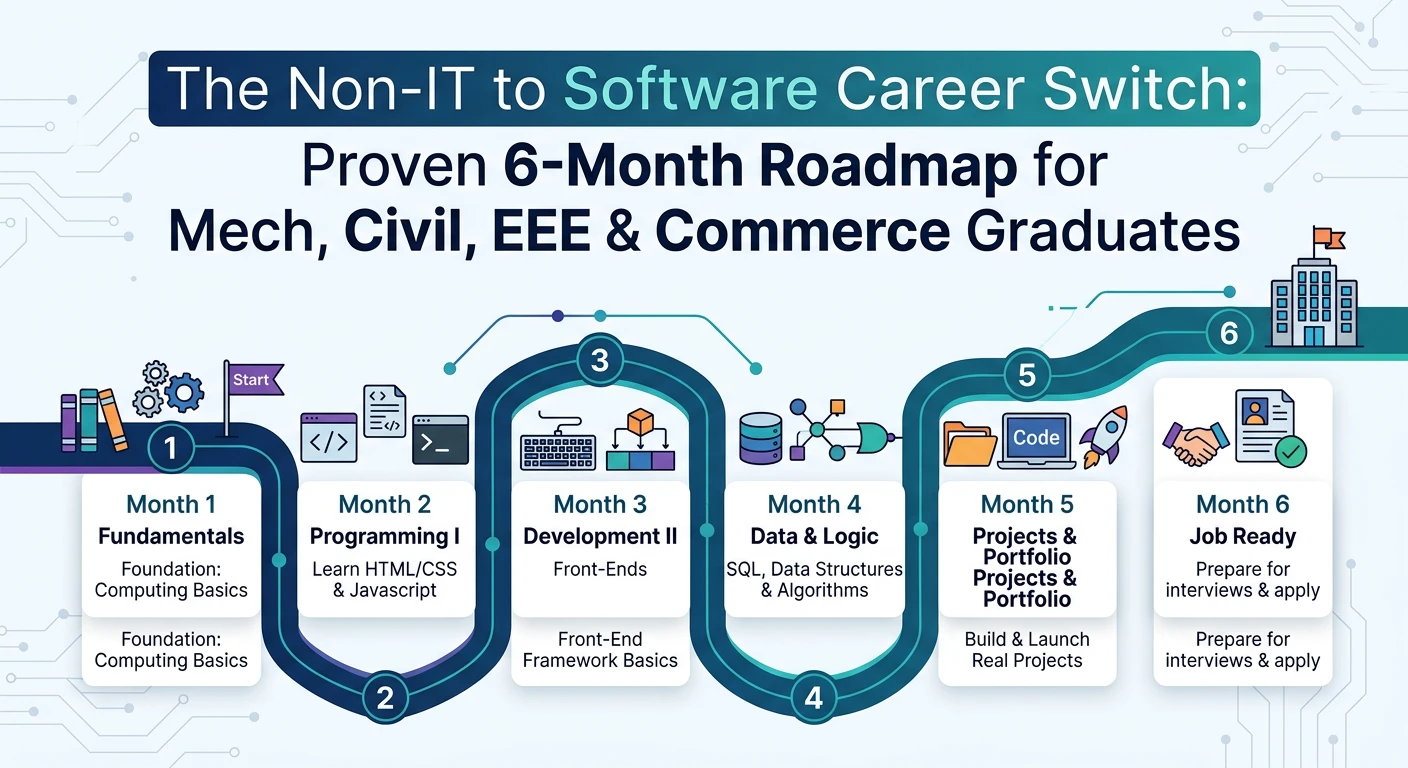
The Month-by-Month 6-Month Non-IT Transformation Blueprint
Transitioning from zero coding knowledge to a hired software engineer in 180 days requires ruthless, disciplined daily execution. You must treat this transition like a full-time professional job: dedicating 4 to 6 focused hours daily, 6 days a week. Follow this precise chronological curriculum:
Month 1: Computational Thinking & Algorithmic Logic Fundamentals
• Goal: Break the fear of code syntax and develop programmatic problem-solving intuition.
• Curriculum: Choose JavaScript (for Full-Stack/QA) or Python (for Data/Embedded). Learn variables, primitive vs reference data types, conditional branching (if/else, switch), loops (for, while), arrays, objects/dictionaries, and functions.
• Hands-On Milestone: Solve 50 foundational logic problems on HackerRank (string reversals, prime number generators, palindrome checkers, array sorting).
• Tooling: Install VS Code, configure Git on your local machine, create a GitHub profile, and commit your code daily.
Month 2: Relational Databases & Structured Query Language (SQL)
• Goal: Master how commercial enterprises store, organize, and manipulate persistent data.
• Curriculum: Relational database concepts, PostgreSQL / MySQL installation, database normalization (1NF, 2NF, 3NF), Primary & Foreign Keys, CRUD operations, advanced multi-table JOIN statements (Inner, Left, Right, Full), aggregate functions (GROUP BY, HAVING), subqueries, and database indexing for query optimization.
• Hands-On Milestone: Architect a complete relational schema for an e-commerce platform or hospital management system; write 25 complex analytical SQL queries.
Month 3: Modern Backend Architecture & RESTful API Engineering
• Goal: Understand how servers process business logic and communicate with databases.
• Curriculum: Client-server architecture, HTTP protocols and status codes (200, 201, 400, 401, 403, 404, 500), Node.js runtime and Express framework (or Python FastAPI), building RESTful API endpoints, request validation, error-handling middleware, password hashing with bcrypt, and secure user authentication using JSON Web Tokens (JWT) with refresh token rotation.
• Hands-On Milestone: Build and test a secure, multi-tenant REST API with automated Postman test collections.
Month 4: Dynamic Frontend Architecture & State Management
• Goal: Build intuitive, responsive user interfaces that connect seamlessly to backend APIs.
• Curriculum: HTML5 semantic structure, modern CSS3 Flexbox and CSS Grid, utility-first styling with Tailwind CSS, React.js fundamentals (JSX, components, props), essential React hooks (useState, useEffect, useRef, useMemo), global state management with Redux Toolkit or Zustand, and asynchronous API integration using Axios with loading and error states.
• Hands-On Milestone: Construct a responsive dashboard featuring interactive data tables, search filters, modal forms, and real-time backend updates.
Month 5: The Commercial Capstone Project & Cloud Deployment
• Goal: Engineer an enterprise-grade 'Proof of Work' application that proves industry readiness.
• Curriculum: Stop building generic tutorial toys (calculators, to-do lists, clones). Build a domain-specific commercial application that bridges your core background with modern tech (e.g., AutoTrack: IoT-Enabled Fleet Telemetry & Maintenance ERP for Mech/Civil; LedgerFlow: Multi-Tenant Invoice Factoring & Automated Reconciliation Engine for Commerce).
• DevOps & Cloud: Containerize your application using Docker; configure a multi-stage Dockerfile; establish automated CI/CD deployment via GitHub Actions; deploy the frontend to Vercel and backend microservices to AWS EC2 or Render with custom domain SSL.
Month 6: The ATS Resume Sprint, Portfolio Defense & Strategic Job Outreach
• Goal: Convert your technical competence into signed corporate job offers.
• Curriculum: Re-architect your resume into a single-column, ATS-optimized layout placing Technical Skills and Live Deployed Projects at the very top, pushing non-CS education to the bottom. Record 2-minute video demonstrations of your live applications. Execute high-velocity outreach on Wellfound, Cutshort, and LinkedIn directly targeting Tech Leads and Startup Founders.
• Mock Interviews: Conduct 10+ recorded technical mock interviews covering Data Structures, SQL query optimization, system design tradeoffs, and the 'Non-IT to IT' transition story.
- Month 1: Core programming syntax, logical loops, and daily GitHub commit hygiene.
- Month 2: PostgreSQL relational schema design, normalization, and advanced multi-table SQL queries.
- Month 3: Secure backend REST API development with JWT authentication and middleware.
- Month 4: Modern React frontend architecture, responsive Tailwind styling, and state management.
- Month 5: Build and deploy one commercial-grade full-stack capstone project to AWS/Vercel.
- Month 6: ATS resume optimization, direct startup outreach, and intensive mock interview drills.
Mastering the Interview: Word-for-Word Scripts for Explaining Your Switch
In every single interview, the hiring manager will lean forward, examine your resume, and ask the inevitable question: 'I see you studied Mechanical (or Civil / Commerce). Why are you applying for a software developer role? Isn't this just because core has no jobs, or because IT pays more?'
How you answer this question determines your fate. If you become defensive, complain about core engineering salaries, or say 'I always loved computers since childhood' (the most clichéd, unconvincing answer in recruitment history), you will be rejected.
Hiring managers want to see deliberate intellectual passion, methodical career ownership, and a clear narrative arc. Here are field-tested, word-for-word scripts that turn your non-CS background into a compelling competitive advantage:
The Winning Script for Mechanical & Civil Engineering Graduates:
'During my mechanical engineering coursework, I enjoyed thermodynamics and structural analysis, but my major breakthrough came during our computer-aided simulation projects. While using finite element analysis software, I became fascinated not just by the mechanical results, but by the computational algorithms and software architectures running beneath the surface.
I realized that in the 21st century, the most powerful mechanical and industrial systems are driven by software. Rather than treating software as a passive tool, I decided to become an active builder. Over the past six months, I applied the same mathematical rigor and systems engineering discipline I learned in core engineering to mastering full-stack web development and cloud infrastructure.
I didn't just watch videos—I built and deployed three production-grade web applications, including an enterprise fleet telemetry platform featuring PostgreSQL database normalization, Docker containerization, and AWS deployment. My core background taught me how physical systems function under pressure; my software skills allow me to translate that discipline into writing clean, scalable production code on day one.'
The Winning Script for Commerce & Arts Graduates:
'While pursuing my commerce degree, I developed a strong foundation in corporate financial statements, taxation workflows, and business transaction lifecycles. However, when observing modern enterprise operations, I noticed that financial departments are constantly bottlenecked by legacy manual data entry and inefficient reporting tools.
I realized that business logic is only as effective as the software engine powering it. I made the deliberate decision to bridge the gap between finance and technology. Over the last six months, I committed 40 hours a week to mastering advanced SQL data modeling, Python data analytics, and full-stack web architecture.
Because of my financial background, I don't just write code blindly; I understand the commercial business impact of every database query and user transaction. For example, my capstone project is an automated invoice reconciliation dashboard that eliminates financial discrepancies. I bring both software engineering competence and genuine business acumen to your engineering team.'
- Never complain about core engineering salaries or blame lack of jobs during an interview.
- Frame your switch as a natural, deliberate evolution toward computational systems building.
- Highlight your core discipline's strengths (systems engineering, mathematical modeling, financial acumen).
- Point immediately to your live deployed capstone project as tangible proof of technical competence.
Bypassing the Gatekeepers: How to Beat Degree Filters in Tech Hiring
If you have a non-CS degree, applying through traditional corporate career portals (like Workday, Taleo, or on-campus college placement drives for mass-recruiters like TCS, Infosys, and Wipro) is playing a rigged game. Mass recruiters process 500,000 applications annually and configure their automated Applicant Tracking Systems (ATS) to automatically reject any resume that does not list 'B.E. Computer Science' or 'B.Tech IT'.
To win, you must bypass the gatekeepers and operate in the High-Growth Competency-Based Tech Market where skills outweigh paperwork:
1. Target Product Startups (Series A to Unicorn) on Wellfound & Cutshort:
Startups on platforms like Wellfound (AngelList) and Cutshort operate with zero academic prejudice. A Series-A startup with 40 developers cannot afford to care whether you studied Mechanical or Computer Science—they have features to ship next Tuesday. Your profile highlights your technical stack, your live deployed URLs, and your GitHub commit graph. Founders and Engineering Managers message you directly based on your code.
2. The Engineering Manager LinkedIn Direct Outreach Method:
Over 70% of high-paying tech jobs are filled through internal referrals. Identify Engineering Managers, Tech Leads, and Senior Software Engineers working at mid-tier product firms and digital agencies in Coimbatore, Chennai, and Bengaluru. Send a concise, 3-sentence technical value message:
'Hi [Name], I noticed your team is scaling your React and Node.js microservices. I recently built and deployed a production-grade fleet management application on AWS featuring Docker and PostgreSQL [Live URL]. I would love to share my codebase and explore any junior software engineering openings on your team.'
When an engineering manager clicks your live URL and sees a fast, responsive, beautifully styled application, they will forward your resume directly to HR with an interview mandate, completely overriding corporate degree filters.
3. Participate in Hackathons & Open-Source Sprints:
Platforms like Unstop, HackerEarth, and Devfolio host open corporate hackathons. When you place in the top 5% of a hackathon or contribute verified bug fixes to a popular open-source repository on GitHub, company recruiters reach out to you with direct technical interview passes.
- Avoid legacy campus portals that enforce automated 'CSE/IT degree only' filters.
- Target fast-moving product startups on Wellfound, Cutshort, and Instahyre.
- Engage directly with practicing Engineering Managers on LinkedIn using live project demos.
- Participate in Unstop and HackerEarth hackathons where leaderboard rankings grant direct interviews.
Defeating the Psychological Battle: Imposter Syndrome & Family Pressure
The technical transition is only half the battle; the emotional and psychological transition is often the harder half. When you announce to your family that you are transitioning to software engineering after spending four years in Mechanical or Civil engineering, you will inevitably encounter resistance:
• 'Why did we spend ₹4 lakhs on your engineering degree if you're just going to sit in front of a computer?'
• 'Your uncle's friend works in a mechanical plant; why don't you take that ₹12,000 supervisor job for experience?'
• 'Computer Science graduates are already struggling; how can you possibly compete with them?'
You must understand that this skepticism comes from love, but it is grounded in outdated 1990s assumptions. Explain to your family calmly: 'A core job pays ₹15,000 with a ₹1,000 annual increment. A software engineering career starts at ₹35,000 to ₹50,000 with exponential growth. Investing six focused months now will permanently change our family's financial trajectory for the next thirty years.'
Conquering Imposter Syndrome:
When you sit down to code and encounter an intimidating error message in the terminal, a toxic voice in your head will whisper: 'You're not smart enough for this. You're just a Mechanical/Civil graduate. Real coders started when they were 12.'
Recognize this for what it is: Imposter Syndrome. Software engineering is not a genetic trait; it is a learned mechanical craft, exactly like learning to drive a car or play an instrument. Every Senior Software Architect at Google was once a beginner who couldn't write an if statement. When you embrace the struggle of debugging as an engineering discipline, your growth accelerates exponentially.
- Educate your family on the long-term financial reality of core vs software career trajectories.
- Recognize Imposter Syndrome as a natural cognitive phase of the learning process.
- Software engineering is an acquired mechanical craft, not an innate genetic gift.
- Every master developer was once a beginner who refused to quit when their code threw an error.
How Beetalogic Accelerates Non-IT Candidates into High-Earning Software Careers
At Beetalogic Software Solutions, with tech academies situated in the heart of Coimbatore and Chennai, we specialize in transforming passionate non-IT graduates into elite, production-ready software engineers.
We have engineered our Non-IT to Software Career Finishing School specifically to eliminate the barriers holding core and commerce graduates back:
• Bilingual, Empathetic Mentorship: Our senior instructors don't use intimidating academic jargon. We explain complex programming concepts using real-world analogies drawn from physical mechanics, construction, and business operations.
• 100% Project-First Pedagogy: You will never sit through passive PowerPoint lectures. From Day 1, you write code in professional IDEs, learn Git branching, containerize apps with Docker, and build commercial-grade full-stack applications.
• 80+ Direct Corporate Hiring Partners: We maintain direct hiring tie-ups with product startups, GCCs, and IT consultancies across Tidel Park Coimbatore, CHIL SEZ, and Chennai OMR. Our hiring partners evaluate candidates exclusively on their Beetalogic capstone projects and coding evaluations—your college degree title is never an obstacle.
• Comprehensive Placement Support: From rebuilding your resume into an ATS-compliant technical format to conducting rigorous technical mock interviews and salary negotiation drills, our placement division stands beside you until you sign your formal offer letter.
Your past degree is merely the first chapter of your life; your software engineering career is completely in your hands. With focused discipline, an undeniable proof-of-work portfolio, and the right mentorship partner, your 6-month transformation starts today.
- Specialized zero-to-hero curriculum tailored for Mechanical, Civil, EEE, and Commerce students.
- Hands-on project-first learning using enterprise tools (Docker, AWS, React, PostgreSQL).
- 80+ corporate hiring partners who prioritize verified project competence over degree titles.
- Dedicated 360-degree placement support with unlimited interview opportunities until offer sign-off.
Explore Local IT Training Programs
Top-rated job-oriented training & internships in Coimbatore & Chennai