

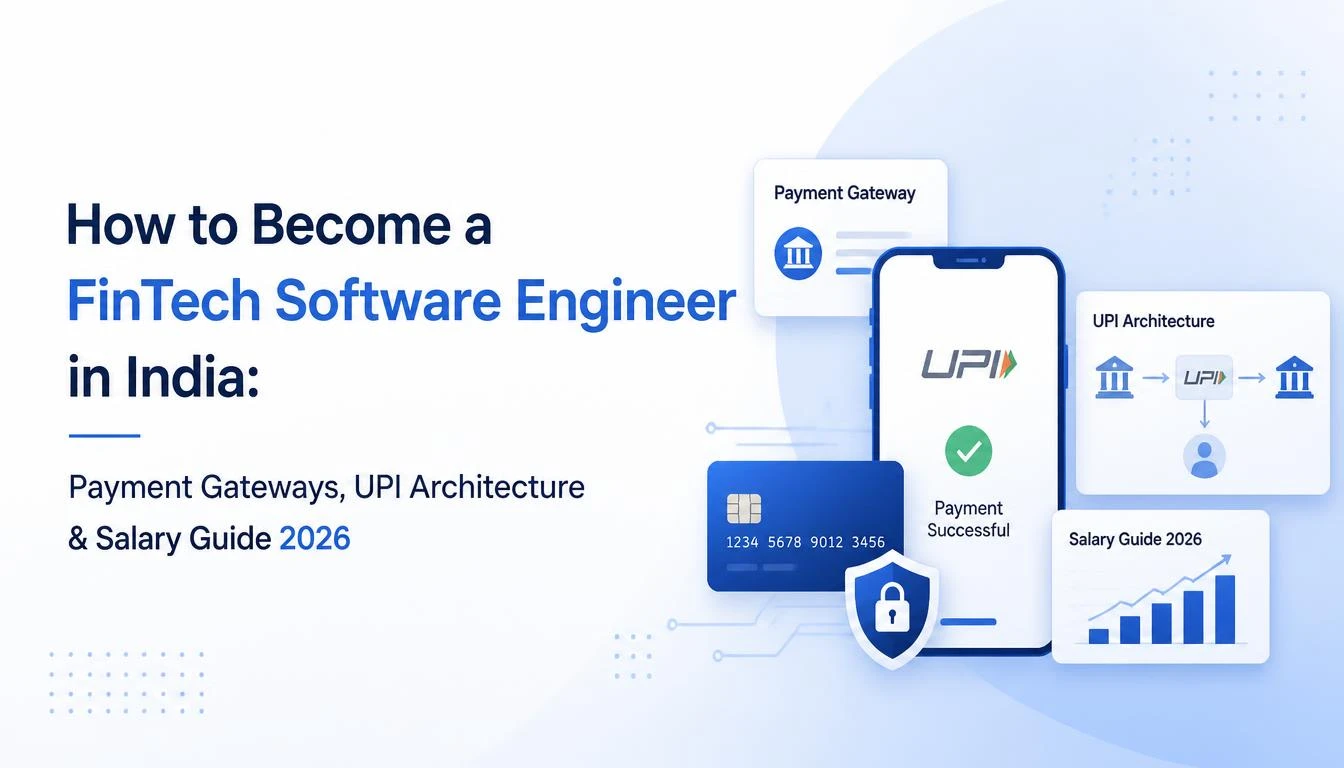
1. The Indian FinTech Miracle: Why Financial Engineering Commands Premium Salaries in 2026
Over the past decade, India accomplished what no other nation on Earth could: transitioning a cash-dominated economy into the world's most advanced real-time digital payment ecosystem. India now accounts for nearly 50% of all real-time digital transactions globally, outstripping the combined transaction volumes of the United States, China, the United Kingdom, and Canada.
This explosive growth has triggered an unprecedented war for engineering talent. Traditional IT service firms historically hired freshers for generic application maintenance at starting salaries of ₹3.5 LPA to ₹5.0 LPA. By contrast, Tier-1 FinTech unicorns and banking technology centers hire specialized financial software engineers at compensation packages that rival Silicon Valley starting tiers:
- Fresher / Entry-Level FinTech Engineers (0–2 years): ₹10.0 LPA to ₹25.0 LPA (consisting of ₹12–18 LPA base salary plus signing bonuses and ESOPs/RSUs).
- Mid-Level FinTech Engineers (3–5 years): ₹22.0 LPA to ₹42.0 LPA.
- Staff FinTech Architects & Systems Leads (6+ years): ₹45.0 LPA to ₹85.0+ LPA, with senior leadership packages exceeding ₹1 Crore CTC.
Why do FinTech companies pay such massive premiums? Because in financial engineering, a single software bug is not an inconvenient support ticket—it is direct monetary loss, regulatory sanction from the Reserve Bank of India (RBI), and catastrophic reputational damage. If an e-commerce platform fails to increment a product like button, nobody notices; if a payment switch drops an authorization response or double-charges 50,000 credit cards during a Diwali flash sale, the company faces multi-million dollar losses and severe legal liability.
- Global Leadership: India processes over 14 billion UPI transactions per month, leading global digital payment volume.
- Massive Salary Advantage: Freshers in FinTech earn ₹10 LPA – ₹25 LPA compared to ₹3.5 LPA at traditional IT service firms.
- Zero-Tolerance Engineering: Financial software demands absolute correctness, mathematically proven consistency, and zero data loss.
- High Growth Sectors: Payment Aggregators (Razorpay, Cashfree), UPI PSPs (PhonePe, Google Pay), WealthTech (Zerodha, Groww), and Global Banks (JPMorgan, Goldman Sachs).
2. Deconstructing the Digital Payment Gateway: How Money Moves on the Internet
When a consumer clicks 'Pay Now' on an e-commerce website or mobile app, they initiate a complex, multi-party distributed orchestration that must complete within 2 to 3 seconds. To build payment systems, you must master the roles of the five core participants in the payment lifecycle:
1. Cardholder / Customer: The consumer initiating the payment from a browser or mobile device.
2. Merchant: The business selling goods or services (e.g., Swiggy, Amazon, or a local retailer).
3. Payment Gateway / Payment Aggregator (PG/PA): The technology bridge (e.g., Razorpay, Stripe, PayU) that encrypts payment details, routes transactions, and coordinates communication between merchants and banks.
4. Acquirer (Merchant's Bank): The financial institution that holds the merchant's business account and processes credit/debit card transactions on their behalf.
5. Card Networks (RuPay, Visa, Mastercard) & Issuer (Customer's Bank): The card network routes the authorization request to the issuing bank (HDFC, SBI, ICICI) which holds the customer's funds, verifies account balance, validates 3D-Secure OTPs, and approves or declines the debit.
The Transaction Lifecycle: Authorization, Capture, and Settlement. Payment processing is fundamentally a two-step handshake. In Step 1 (Authorization), the customer's bank verifies available credit/balance and places a temporary hold on the funds. In Step 2 (Capture), the merchant confirms that the order was fulfilled, converting the authorization hold into an actual transfer request. If the merchant cancels the order before fulfillment, the authorization is 'Voided' instantly without any debit hitting the customer's statement.
Bulletproof Idempotency Keys: The #1 Pattern in Financial APIs. In distributed systems, networks are inherently unreliable. If a mobile user taps 'Pay' and their cellular connection drops while waiting for the response, the mobile app automatically retries the request. Without idempotency, the user would be charged twice. FinTech backends require an 'Idempotency-Key' (typically a client-generated UUIDv4) in the HTTP header. The backend acquires an atomic distributed lock in Redis for that key. If an identical request arrives while the first is processing, the duplicate is blocked. Once the transaction completes, the final response is cached in Redis with a 24-hour TTL; any subsequent retry with that same key immediately returns the cached response with zero duplicate database writes.
- The 5-Party Ecosystem: Cardholder, Merchant, Payment Gateway/Aggregator, Acquirer Bank, and Issuer Bank.
- Two-Step Processing: Authorization (fund reservation) followed by Capture (fund collection) or Void (fund release).
- Idempotency Architecture: Using UUIDv4 headers and Redis distributed locks to mathematically prevent duplicate billing.
- Webhook Resilience: Secure callback delivery using HMAC-SHA256 signatures, exponential backoff retries, and dead-letter queues (DLQ).
3. UPI 2.0 & The NPCI Switch: The Anatomy of Real-Time Payment Architecture
The Unified Payments Interface (UPI) built by the National Payments Corporation of India (NPCI) is one of the most sophisticated distributed payment protocols ever engineered. It enables interoperable, real-time, peer-to-peer (P2P) and peer-to-merchant (P2M) fund transfers between any two bank accounts in India instantaneously.
Virtual Payment Addresses (VPA) & Tokenized Privacy: In legacy banking (NEFT/RTGS), transferring money required revealing sensitive account numbers, branch IFSC codes, and account holder names. UPI abstracts these sensitive credentials behind a Virtual Payment Address (e.g., 'username@okhdfcbank' or 'mobile@ybl'). The NPCI central directory maintains a secure mapping of VPAs to underlying Core Banking System (CBS) account numbers.
The Core UPI Transaction Flows:
1. Dynamic QR & Intent Flow (P2M): When a merchant app generates a dynamic UPI QR code, it embeds custom query parameters: 'upi://pay?pa=merchant@icici&pn=Store&am=450.00&tr=TXN987654&mc=5411'. In mobile apps, clicking 'Pay via UPI' triggers an Android Intent that launches installed PSP apps directly, eliminating manual VPA typing.
2. Collect Request Flow: A merchant sends an asynchronous payment request to a customer's VPA. The NPCI switch routes the collect request to the customer's PSP app. Once the customer enters their secret 4 or 6-digit UPI PIN (which is encrypted using the bank's public key inside a secure hardware enclave), the transaction executes.
3. UPI Autopay (Recurring Mandates): Modern FinTech engineers must build support for UPI Autopay for subscriptions (OTT platforms, SIP investments, loan EMIs). This involves creating an e-mandate where users pre-authorize automated debits up to specified limits without requiring an OTP/PIN for each recurring billing cycle.
Handling Network Timeouts & Asynchronous Status Reconciliation: When a Remitter bank debits money but the Beneficiary bank's CBS fails to confirm receipt within 15 seconds, the transaction enters a 'Pending' or 'Deemed Approved' state. FinTech backends must implement automated polling workers with exponential backoff and reconcile against end-of-day NPCI settlement reports (NTS and CBR files) to ensure transactions are either credited or auto-reversed within RBI-mandated T+1 timelines.
- NPCI Central Switch: High-throughput financial message router connecting 500+ commercial and cooperative banks.
- Intent vs Collect Workflows: Optimizing checkout conversions using mobile-native deep linking and in-app UPI intents.
- UPI Autopay Architecture: Managing digital recurring payment mandates with automated webhook notifications.
- Asynchronous Reconciliation: Automated background status checks resolving pending edge cases to ensure zero lost funds.
4. Immutable Double-Entry Ledgers: The Core Engine of Financial Backends
The most catastrophic mistake junior engineers make when building financial applications is creating a database table with a mutable balance column: 'UPDATE accounts SET balance = balance - 100 WHERE id = 123'. In a production FinTech system, this approach is completely unacceptable.
Why Mutable Balances Cause Catastrophic Failure: A single unexpected server crash, database deadlock, or concurrent race condition during a write operation will corrupt the balance. Worse, you will have zero audit trail explaining where the money went or why the numbers no longer balance. In FinTech, you can never prove the current state without an immutable history of every single transaction.
The Golden Law: Double-Entry Bookkeeping. Developed in 1494 by Franciscan friar Luca Pacioli, double-entry bookkeeping remains the foundational mathematical pillar of global commerce and modern FinTech engineering. In double-entry accounting:
- Every financial transaction must be recorded as an immutable pair: at least one Debit and at least one Credit.
- Mathematical Law of Conservation: The sum of debits must ALWAYS equal the sum of credits (Σ Debits == Σ Credits). Money is never created from thin air or destroyed; it is only transferred between accounts.
The 5 Core Account Categories: Assets (cash, bank deposits), Liabilities (loans, merchant payables), Equity (owner capital), Revenues (merchant processing fees), and Expenses (card interchange fees paid to Visa/Mastercard). For example, when a user deposits ₹1,000 into a digital wallet, the system records: Debit Cash Asset (+₹1,000) and Credit User Wallet Liability (+₹1,000). The equation remains perfectly balanced.
Database Design for Zero-Drift Ledgers: In modern PostgreSQL backends, financial ledgers are designed as strictly append-only tables: 'INSERT' operations are permitted, but 'UPDATE' and 'DELETE' privileges are completely revoked at the database role level. If an erroneous transaction occurs, developers never delete the row; instead, they record a compensating reversal entry. Live account balances are never stored as single numbers—they are derived by aggregating the immutable transaction log or cached in Redis using distributed locks (Redlock) during high-throughput concurrent wallet debits.
- Append-Only Architecture: Mathematical prohibition of UPDATE and DELETE operations on financial ledger rows.
- Debit-Credit Conservation: Enforcing that Σ Debits strictly equals Σ Credits inside atomic database transactions.
- Derived Account Balances: Treating balance numbers as materialized views or cached aggregates of the transaction log.
- Concurrency Controls: Implementing pessimistic locking (SELECT ... FOR UPDATE) to prevent double-spending in digital wallets.
5. End-of-Day Financial Reconciliation, ISO 8583/20022 & Settlement Engines
In a perfect world, every payment processed by your system would match the bank's records down to the last paisa. In reality, modern payments operate across dozens of decoupled microservices and independent banking networks where network partitions, server reboots, and timing differences are routine. This makes Financial Reconciliation the unsung hero of FinTech engineering.
The Three-Way Matching Dilemma: Every night, FinTech platforms execute automated reconciliation jobs that perform three-way matching between:
1. Internal Order Database: The merchant's internal ledger recording transactions initiated by customers.
2. Payment Gateway Transaction Logs: The aggregator's record of authorized and captured payments.
3. Bank Settlement Files: The actual clearing and settlement files provided by the acquiring bank and NPCI (such as MT940, CAMT.053, or raw CSV reports).
Handling Discrepancies & Merchant Payouts: High-performance reconciliation engines ingest multi-gigabyte settlement files using streaming parsers (written in Go or Java) to match each transaction's Unique Transaction Reference (UTR). The engine detects anomalies: transactions debited by the bank but marked failed by the merchant, delayed settlements, chargebacks, and gateway processing fee deductions (MDR). Once matched, automated payout engines calculate net balances and disburse merchant settlements on T+1 or T+2 schedules via automated NEFT/IMPS/RTGS payout APIs.
Financial Messaging Standards: ISO 8583 vs ISO 20022. Traditional card networks and ATM switches communicate using ISO 8583—a compact binary standard utilizing Message Type Indicators (MTIs), Bitmaps, and 128 fixed Data Elements designed for low-bandwidth 1980s telecommunications. In 2026, the global banking industry is completing its migration to ISO 20022—a modern, structured XML and JSON standard that provides rich metadata, end-to-end payment tracking, and standardized remittance information across global cross-border corridors (SWIFT).
- Three-Way Reconciliation: Reconciling internal order logs, payment gateway records, and bank clearing files.
- Batch Settlement Ingestion: Streaming parsers processing multi-gigabyte settlement dumps with automated discrepancy flagging.
- Merchant Payout Automation: Programmatic calculation of net settlements after deducting MDR fees and processing payouts.
- Protocols Mastery: Understanding legacy binary ISO 8583 card switches and modern XML/JSON ISO 20022 financial standards.
6. Security, Compliance & Regulatory Architecture: PCI-DSS v4.0 and RBI Mandates
In FinTech, security is not an afterthought; it is built into the architecture from the very first line of code. Financial systems are prime targets for cyber criminals and operate under strict oversight from national regulators like the Reserve Bank of India (RBI).
PCI-DSS v4.0 & Minimizing CDE Scope: Any organization that processes, stores, or transmits credit/debit card details must comply with the Payment Card Industry Data Security Standard (PCI-DSS). Version 4.0 mandates 12 rigorous security goals, including multi-factor authentication for all administrative access, continuous automated vulnerability scanning, and strict data encryption. To avoid the massive expense and legal liability of maintaining a full Cardholder Data Environment (CDE), modern FinTech architects use Hosted Fields and iFrames. By having the customer enter their 16-digit card number directly into an encrypted iFrame hosted by the payment gateway, raw card data never touches the merchant's servers or memory buffers, drastically reducing compliance overhead.
Network Tokenization: In accordance with RBI tokenization guidelines, merchants and payment aggregators can no longer store raw card numbers (PAN) or expiry dates on their databases. Instead, card networks (Visa, Mastercard, RuPay) generate unique cryptographic 'Tokens' tied specifically to that merchant, device, and customer. Even if a merchant's database is compromised, the stolen tokens are mathematically useless to hackers.
Hardware Security Modules (HSMs) & Cryptography: Banks and payment switches rely on dedicated physical Hardware Security Modules (HSMs) to perform cryptographic operations. HSMs handle PIN block encryption, generation of Zone PIN Keys (ZPK), and validation of Card Verification Values (CVV) inside physically tamper-resistant silicon chips that zeroize their memory if breached.
RBI Data Localisation Mandate: The RBI mandates that all payment data of Indian citizens—including end-to-end transaction details, customer identifiers, and audit logs—must be stored exclusively on physical servers located within the territorial borders of India. FinTech architectures must ensure that multi-cloud deployments (AWS Mumbai/Hyderabad, GCP Delhi/Mumbai, Azure Central India) strictly comply with local data sovereignty laws.
- PCI-DSS v4.0 Scope Reduction: Leveraging hosted iFrames and tokenization to keep raw card data off application servers.
- RBI Tokenization Framework: Replacing sensitive card numbers with merchant-specific cryptographic tokens.
- Hardware Security Modules (HSMs): Hardware-accelerated financial encryption and secure PIN block verification.
- Data Localisation: Ensuring cloud infrastructure and transaction logs remain 100% within Indian borders.
7. The 2026 FinTech Career Roadmap & Launching Your Career with Beetalogic
Becoming a high-earning FinTech software engineer requires a deliberate combination of systems engineering, database mastery, and domain-specific financial knowledge. Here is the step-by-step roadmap to prepare for top-tier FinTech engineering interviews in 2026:
Step 1: Master High-Performance Backend Languages. Specialize in Java (Spring Boot) or Go (Golang). FinTech backends require strict typing, high concurrency, and low memory overhead.
Step 2: Database Concurrency & ACID Mastery. Master PostgreSQL transaction isolation levels (Read Committed vs Serializable), row-level locking (SELECT FOR UPDATE), and Redis caching.
Step 3: Event-Driven Architecture. Learn Apache Kafka. Understand consumer groups, partition keys, exactly-once processing semantics, and the Transactional Outbox Pattern to guarantee message delivery between microservices.
Step 4: Build Real FinTech Projects. Don't build generic to-do apps. Build: (1) An Idempotent Payment Gateway Checkout Service with webhook retries, (2) An Immutable Double-Entry Ledger Engine with balance conservation checks, and (3) An End-of-Day Multi-Way Reconciliation Script matching simulated bank settlement files.
Launch Your Career with Beetalogic Software Solutions: At Beetalogic in Coimbatore (P N Palayam) and Chennai, our Masterclass in FinTech Engineering, Digital Payment Gateways & Banking API Architecture bridges the gap between academic theory and lucrative enterprise FinTech careers. You will learn directly from experienced software architects who have designed high-scale transaction systems. Through hands-on coding labs, production architecture defense sessions, and 100% placement support with leading FinTech startups, banking GCCs, and payment service providers across Tamil Nadu and Bengaluru, Beetalogic is your gateway to an elite financial software engineering career.
- Hands-On FinTech Simulators: Build a real payment gateway integration, double-entry ledger, and reconciliation engine.
- Production Curriculum: Master Java/Go, PostgreSQL, Redis, Kafka, UPI 2.0, ISO 8583/20022, and PCI-DSS v4.0.
- Elite Interview Preparation: Specialized coaching on System Design interviews ('Design a Digital Wallet', 'Design a Payment Switch').
- Direct Placement Support: Exclusive interview referrals to leading FinTech unicorns, GCCs, and digital banking platforms.
Explore Local IT Training Programs
Top-rated job-oriented training & internships in Coimbatore & Chennai