

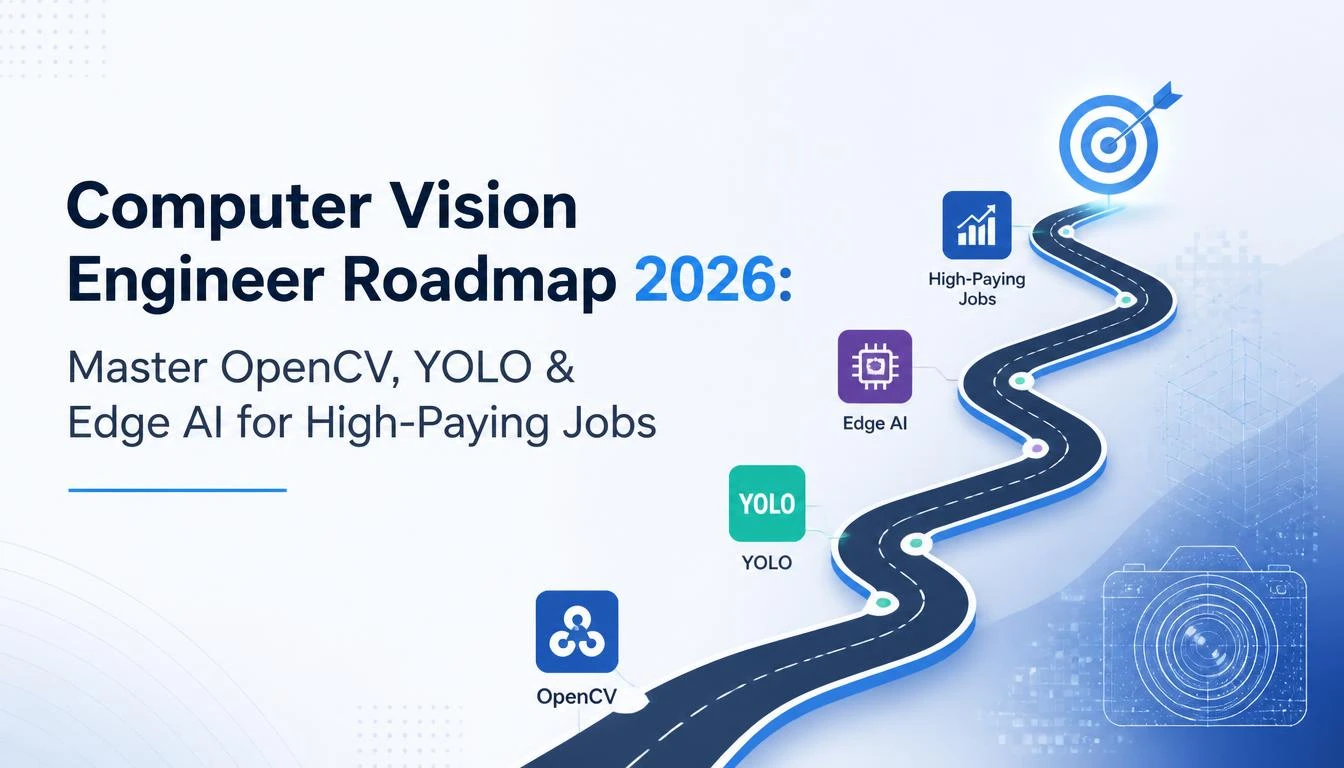
1. The Visual AI Revolution: Why Computer Vision is the Ultimate Frontier in 2026
To understand the explosive demand for Computer Vision in 2026, look at the physical automation taking place across global industries. In semiconductor and automotive manufacturing, Automated Optical Inspection (AOI) systems inspect thousands of microchips and precision welds per minute with microscopic precision that exceeds human optical capability. In healthcare, deep learning vision models analyze MRI, CT scans, and pathology slides to detect early-stage oncological anomalies. In retail and logistics, autonomous mobile robots (AMRs) navigate complex warehouse floors using visual Simultaneous Localization and Mapping (vSLAM).
This industrial expansion has created a surging demand for specialized Computer Vision and Edge AI talent across Indian tech hubs (Bengaluru, Chennai, Hyderabad, and Coimbatore) and multinational capability centers. Compensation benchmarks for Computer Vision Engineers in 2026 reflect this specialized premium:
- Entry-Level / Fresher CV Engineers (0–2 years): ₹6.0 LPA to ₹14.0 LPA at top AI startups, semiconductor giants (NVIDIA, Intel, Qualcomm), and automotive Tier-1 suppliers.
- Mid-Level CV Engineers (3–5 years): ₹15.0 LPA to ₹28.0 LPA.
- Staff Vision Architects & Edge AI Leads (6+ years): ₹30.0 LPA to ₹65.0+ LPA, with international remote positions paying 110,000 to 200,000+ USD.
The Critical Hiring Shift: The 'Colab Engineer' is Dead. The biggest mistake aspiring engineers make is believing that calling 'model.predict()' on static JPG files qualifies them for industry roles. In production, computer vision is a systems engineering challenge: handling variable lighting, camera sensor noise, rolling shutter distortion, dropped RTSP network packets, and strict latency budgets (less than 33 milliseconds per frame for 30 FPS real-time operation). Employers in 2026 seek engineers who understand the entire pipeline—from camera lenses and OpenCV preprocessing to TensorRT GPU acceleration on edge devices.
- Ubiquitous Industry Impact: Powering autonomous vehicles, medical diagnostics, robotics, and industrial quality inspection.
- Lucrative Salary Benchmarks: Freshers earn ₹6 LPA – ₹14 LPA, while senior Edge AI leads command ₹30 LPA – ₹65+ LPA.
- The Production Reality: Companies hire engineers who build end-to-end, low-latency video streaming pipelines, not just notebook scripts.
- Hardware & Semiconductor Boom: Massive hiring from NVIDIA, Qualcomm, Intel, Bosch, Continental, and smart robotics startups.
2. The Mathematical & Classical Foundation: Mastering OpenCV 5 & Digital Image Processing
Every elite computer vision journey begins with classical digital image processing. Before a neural network ever sees an image, the raw pixel array must be decoded, normalized, filtered, and transformed. Engineers who skip classical computer vision struggle when their deep learning models fail under unexpected lighting or distorted angles.
Pixel Representation & Color Spaces: An image is fundamentally a multidimensional numerical tensor. You must understand how digital sensors store pixels—from 8-bit unsigned integers (uint8, values 0–255) to normalized floating-point arrays (float32, values 0.0–1.0). You must master Color Spaces beyond standard RGB/BGR: HSV (Hue, Saturation, Value) is essential for lighting-invariant color segmentation, while LAB isolates perceptual lightness (L) from color channels (A and B), enabling powerful adaptive histogram equalization (CLAHE).
Spatial Filtering & Edge Detection: Spatial convolution kernels are the fundamental building blocks of both classical processing and modern CNNs. Master Gaussian Blur for noise suppression, Bilateral Filtering for smoothing noise while preserving crisp object edges, Sobel and Laplacian gradient operators for boundary analysis, and the multi-stage Canny Edge Detection algorithm (gradient calculation, non-maximum suppression, and hysteresis thresholding).
Morphological Operations & Contours: Learn mathematical morphology: Erosion (stripping boundary pixels), Dilation (expanding object boundaries), Opening (removing background salt noise), and Closing (bridging micro-gaps in object silhouettes). Combine these with Contour Analysis to compute bounding boxes, convex hulls, center moments, and object surface areas without needing neural networks.
Geometric Transformations & Homography: Master affine transformations, camera calibration using chessboard patterns to eliminate lens distortion, and Homography matrix estimation. Homography allows you to project an angled perspective camera view (e.g., a roadside CCTV feed) into a planar bird's-eye perspective, enabling mathematically accurate vehicle speed measurement and athletic player tracking.
- Tensor Foundations: Understanding image dimensions, channel layouts (HWC vs CHW), and bit depth conversions.
- Color Space Mastery: Leveraging HSV and LAB color models to build robust, lighting-invariant preprocessing filters.
- Edge & Morphology: Applying Canny detection, Bilateral filters, and morphological operations for contour extraction.
- Perspective Homography: Rectifying angled video feeds into calibrated bird's-eye coordinates for spatial analytics.
3. Deep Learning for Vision: PyTorch, Modern CNNs & Vision Transformers (ViT)
While classical techniques handle filtering and geometry, deep learning provides the semantic understanding required to recognize complex objects, classify textures, and detect anomalies. In 2026, PyTorch is the undisputed lingua franca of computer vision research and enterprise engineering.
Convolutional Neural Network (CNN) Mechanics: Understand how 2D convolutions slide learnable filter weights across spatial dimensions to extract local visual patterns. Grasp the interplay between receptive fields, strides, zero-padding, activation functions (ReLU, SiLU, GELU), and Batch Normalization. Study the evolution of modern CNN backbones: from classical ResNet (which introduced residual skip connections to solve vanishing gradients) to modern ConvNeXt, EfficientNet (compound scaling of depth, width, and resolution), and MobileNetV4 (optimized for mobile NPUs).
Building Production Data Pipelines with Albumentations: Models are only as good as the data they train on. Novices use simple horizontal flips; elite vision engineers build complex data augmentation pipelines using Albumentations. Master CutMix and MixUp (blending image patches and labels), Mosaic augmentation (combining four random images into one to teach the model multi-scale detection), Random Affine transformations, and Color Jitter to bulletproof models against overfitting.
The Vision Transformer (ViT) Revolution: In 2020, Google published 'An Image is Worth 16x16 Words', demonstrating that pure Transformer architectures without convolutions can achieve state-of-the-art visual accuracy. In a Vision Transformer (ViT), an image is split into a grid of non-overlapping patches (e.g., 16x16 pixels). Each patch is flattened, linearly projected into a 1D embedding, combined with learnable 1D position encodings, and fed into a standard Transformer encoder with Multi-Head Self-Attention. Unlike CNNs, which have localized receptive fields, Transformers possess a global receptive field from the very first layer, capturing long-range contextual relationships across the entire image.
Foundation Vision Models: In 2026, modern vision engineers build upon foundational models: OpenAI CLIP (Contrastive Language-Image Pretraining) for zero-shot image classification and visual search, Meta's Segment Anything Model (SAM / FastSAM) for zero-shot promptable segmentation, and Vision-Language Models (VLMs like LLaVA) for visual question answering.
- PyTorch Ecosystem: Building modular Dataset, DataLoader, and training loops with multi-GPU distributed data parallel (DDP).
- Modern CNN Backbones: Understanding ConvNeXt, EfficientNet, and MobileNetV4 architectures for diverse deployment targets.
- Albumentations Augmentation: Mastering Mosaic, CutMix, MixUp, and affine transforms to eliminate overfitting.
- Vision Transformers (ViT): Exploiting self-attention mechanisms and patch embeddings for global visual contextual reasoning.
- Foundation Vision Models: Integrating CLIP and Segment Anything (SAM) for zero-shot classification and instant mask generation.
4. State-of-the-Art Object Detection, Segmentation & Tracking: Mastering YOLO11
Object detection is the single most widely deployed computer vision task in commercial industry. Unlike basic classification which outputs a single label for an entire image, object detection identifies multiple objects simultaneously, outputting bounding box coordinates (x, y, width, height) and class confidences.
Two-Stage vs One-Stage Detectors: Understand the architectural trade-offs. Two-stage detectors like Faster R-CNN first propose regions of interest (RPN) and then classify each region; they provide high accuracy but operate slowly (10–15 FPS). One-stage detectors—dominated by the YOLO (You Only Look Once) architecture—frame detection as a single regression problem directly from pixels to bounding box coordinates, delivering blistering speeds of 60 to 120+ FPS.
Deep Dive into Modern YOLO Architectures (YOLOv8, YOLOv10, and YOLO11): The modern YOLO family represents the absolute pinnacle of real-time computer vision engineering:
- Decoupled Anchor-Free Heads: Separating classification and bounding box regression into independent parallel neural network branches.
- NMS-Free Dual Label Assignment (YOLOv10 / YOLO11): Historically, object detectors required Non-Maximum Suppression (NMS)—an expensive post-processing step on the CPU that filters overlapping candidate boxes. YOLO11 introduces dual label assignments during training, allowing the model to make direct, one-to-one predictions during inference, completely eliminating NMS latency bottlenecks.
- Advanced Regression Losses: Utilizing Complete IoU (CIoU) and Distribution Focal Loss (DFL) to achieve sub-pixel bounding box accuracy.
Instance Segmentation & Keypoint Pose Estimation: Moving beyond bounding boxes, YOLO-seg predicts pixel-level polygon masks for irregular shapes (e.g., detecting cracks in concrete or identifying tumors in ultrasound scans). YOLO-pose predicts 17 anatomical human keypoints in real time, enabling ergonomic monitoring, athletic movement analysis, and industrial slip-and-fall detection.
Multi-Object Tracking (MOT) with ByteTrack: Object detection only processes individual frames in isolation. To track objects over time, you must maintain object identities across video frames. ByteTrack is the industry gold standard: it leverages a Kalman Filter to predict object motion trajectories and matches bounding boxes across frames using the Hungarian algorithm, uniquely associating both high-confidence and low-confidence detections to maintain tracking continuity even during severe physical occlusions.
- One-Stage Detector Dominance: Achieving real-time 60+ FPS inference speeds across complex multi-class video feeds.
- YOLO11 Architectural Breakthroughs: NMS-free dual label assignments, C3k2 feature extractors, and Area Attention modules.
- Instance Segmentation: Generating pixel-accurate contour masks for complex, irregularly shaped defect analysis.
- ByteTrack Multi-Object Tracking: Maintaining persistent object identities across occlusions with Kalman Filter velocity estimation.
5. Edge AI & High-Speed Inference Optimization: TensorRT, ONNX & NVIDIA Jetson
In real-world computer vision, cloud computing is often a non-starter. Streaming high-resolution 4K 60FPS video feeds from 50 cameras to an AWS or Google Cloud server consumes colossal network bandwidth, incurs prohibitive cloud egress bills, and introduces network latency that makes real-time robotics or automated vehicle braking impossible. The industry demands Edge AI—running inference directly on embedded edge devices at the physical point of capture.
The Model Optimization Pipeline: Transitioning a model from PyTorch training to edge deployment involves three critical stages:
Stage 1: ONNX Graph Export. Exporting the trained PyTorch model (.pt) into the Open Neural Network Exchange (ONNX) format. This creates a serialized, language-agnostic computational graph with static input dimensions, decoupling the model from Python.
Stage 2: NVIDIA TensorRT Engine Compilation. TensorRT is NVIDIA's low-level inference compiler for CUDA GPUs. It parses the ONNX graph, eliminates unused operational nodes, performs layer and tensor fusion (e.g., fusing Convolution, Bias, and ReLU into a single kernel launch), and auto-tunes execution for the target GPU's physical silicon microarchitecture.
Stage 3: Precision Quantization (FP32 -> FP16 -> INT8). Standard models train using 32-bit floating point numbers (FP32). Converting weights to 16-bit half-precision (FP16) doubles inference throughput with zero loss in visual accuracy. Performing INT8 quantization compresses weights into 8-bit integers using calibration datasets to compute scale factors, reducing model memory footprints by 75% and unlocking up to 4x throughput boosts on NVIDIA Tensor Cores.
Deploying to NVIDIA Jetson Hardware: The NVIDIA Jetson platform (Jetson Orin Nano, Jetson Orin NX, and Jetson AGX Orin) delivers 40 to 275 TOPS of AI compute in a compact, power-efficient form factor (7W–60W). Engineers leverage NVIDIA DeepStream SDK and GStreamer hardware decoders (NVDEC) to ingest multiple RTSP video streams, perform zero-copy GPU memory transfers, and execute TensorRT inference pipelines at 30+ FPS per camera stream simultaneously.
- The Edge AI Imperative: Slashing bandwidth costs and achieving sub-20ms latency for robotics and mission-critical automation.
- ONNX Standardization: Exporting hardware-independent computational graphs for seamless cross-platform deployment.
- NVIDIA TensorRT Acceleration: Layer fusion and kernel auto-tuning for maximum GPU utilization.
- INT8 Quantization: Slashing model memory footprints by 75% and unlocking 4x throughput on dedicated Tensor Cores.
- NVIDIA Jetson Deployment: Building multi-camera real-time video analytics engines using DeepStream and GStreamer.
6. Building a Production Vision Portfolio & Launching Your Career with Beetalogic
To stand out to top corporate recruiters and AI engineering managers in 2026, you must prove that you can build production-ready systems that solve actual business problems. Here are three high-impact portfolio projects that immediately differentiate candidates:
Project Blueprint 1: Edge-Accelerated Industrial Automated Optical Inspection (AOI). Curate a dataset of industrial PCB defects (solder bridging, missing components, scratch marks). Train a custom YOLO11 model, optimize it with TensorRT INT8 quantization, deploy it on an NVIDIA Jetson device processing a simulated camera feed at 45 FPS, and generate automated PDF inspection reports with microsecond timestamps.
Project Blueprint 2: Smart City Traffic & Multi-Camera Analytics System. Ingest RTSP video feeds from traffic cameras. Implement vehicle detection and classification, track trajectories using ByteTrack, apply perspective homography transformation to calculate real-world vehicle speeds, detect illegal lane changes, and broadcast alert telemetry via WebSockets to a live dashboard.
Project Blueprint 3: Industrial Health, Safety & PPE Compliance Sentinel. Build a multi-task vision pipeline that monitors factory environments in real time. Detect worker hardhats, high-visibility reflective vests, and safety goggles. Combine object detection with YOLO-pose to detect worker falls or dangerous proximity to heavy machinery, firing automated alerts to plant supervisors within 100 milliseconds.
Launch Your Computer Vision Career with Beetalogic Software Solutions: At Beetalogic in Coimbatore (P N Palayam) and our training centers in Chennai, our Masterclass in Computer Vision, OpenCV & Real-Time Video Analytics with Deep Learning bridges the gap between academic theory and high-paying AI engineering roles. You will work directly with real edge hardware (NVIDIA Jetson, camera sensors), train custom vision models on high-performance GPU workstations, compile TensorRT engines, and build live multi-stream video analytics pipelines under the mentorship of veteran AI practitioners. With 100% placement support, mock technical interviews, and corporate referrals across Tamil Nadu and Bengaluru, Beetalogic is your gateway to an elite career in visual artificial intelligence.
- Hands-On Hardware Labs: Work directly with NVIDIA Jetson edge kits, RTSP video streams, and GPU acceleration.
- Industry-Standard Curriculum: Comprehensive coverage of OpenCV 5, PyTorch, YOLO11, ViT, ByteTrack, TensorRT, and DeepStream.
- Production Project Portfolio: Build real-world industrial AOI, smart surveillance, and worker safety vision engines.
- 100% Placement & Referral Support: Direct interview connections with top AI startups, semiconductor giants, and automotive tech firms.
Explore Local IT Training Programs
Top-rated job-oriented training & internships in Coimbatore & Chennai