

1. What Is Full Stack Development?
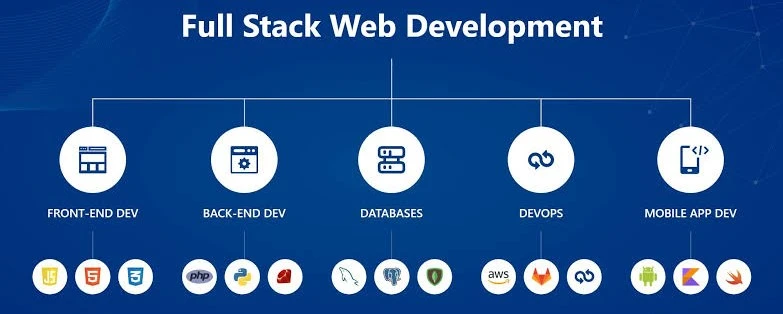
Full stack development refers to the development of web applications across the major layers of a software system. A full stack developer works with the technologies responsible for the user interface, server-side application logic, data storage, communication between systems, and deployment of the application.
The word 'stack' refers to the collection of technologies used to build and operate an application. A modern application may have a frontend built with HTML, CSS, JavaScript, or a framework such as React, a backend built with Node.js, Java, Python, PHP, or .NET, a relational or NoSQL database, APIs for communication, and cloud infrastructure for deployment.
Being a full stack developer does not necessarily mean being an expert in every technology available. It means understanding how the major parts of an application fit together and being capable of developing, connecting, testing, and maintaining those parts as required by a project.
The exact technology stack can vary from one company or project to another. The underlying concepts, however, remain relatively consistent: users interact with a frontend, the frontend communicates with backend services, backend services work with data and business rules, and the completed application runs on infrastructure that users can access.
- Frontend development
- Backend development
- API development and integration
- Database management
- Authentication and authorization
- Testing and debugging
- Deployment and hosting
- Application maintenance
2. The Major Layers of a Modern Web Application
A useful way to understand full stack development is to divide a web application into several logical layers. These layers are connected, but each has a different responsibility.
The presentation layer is what users interact with. It includes pages, buttons, forms, navigation, dashboards, animations, and responsive layouts. The application or backend layer contains business rules and processes requests from the frontend. The data layer stores information such as user accounts, products, orders, messages, and application settings.
Between these layers, APIs provide structured communication. Infrastructure and deployment services make the application available over the internet and provide resources such as servers, databases, storage, networking, monitoring, and security controls.
These layers are not always deployed as completely separate systems. A small application may combine several responsibilities in one project, while a large enterprise application may contain many independent services. The architecture depends on the application's size, requirements, traffic, team structure, and operational needs.
- Presentation layer → user interface and interaction
- Frontend application → browser-side behavior
- API layer → communication between application components
- Backend layer → business logic and server-side processing
- Database layer → persistent data storage
- Infrastructure layer → hosting, networking, deployment, and monitoring
3. What Is Frontend Development?
Frontend development focuses on the part of a web application that runs in the user's browser or is directly presented to the user. It determines how information is displayed and how users interact with the application.
HTML provides the basic structure of a webpage, CSS controls presentation and layout, and JavaScript adds dynamic behavior. Modern applications often use frontend frameworks and libraries to manage complex interfaces. React, Angular, Vue, and other technologies can help developers build reusable components and interactive applications.
A frontend developer also needs to think about responsive design. A web application should work across different screen sizes, including desktop monitors, laptops, tablets, and mobile devices. Accessibility, performance, browser compatibility, and user experience are also important parts of frontend development.
For example, consider an online shopping page. The product images, product information, search box, filters, shopping cart button, and checkout form are all part of the frontend experience. However, the frontend does not normally contain the complete product database or payment-processing logic. It communicates with backend services to obtain and submit the required information.
- HTML for document structure
- CSS for layout and visual presentation
- JavaScript for application behavior
- Frontend frameworks and libraries
- Responsive design
- Accessibility
- Browser compatibility
- Frontend performance optimization
4. What Is Backend Development?
Backend development focuses on the server-side logic that operates behind the user interface. The backend receives requests, applies business rules, communicates with databases and other services, and returns appropriate responses.
Suppose a user submits a registration form. The frontend can collect the name, email address, and password, but the backend should validate the information, apply account rules, securely process the password, check whether the email already exists, create the account record, and return the appropriate result.
Backend technologies vary widely. Java and Spring Boot, C# and .NET, Python frameworks such as Django or FastAPI, PHP frameworks such as Laravel, and JavaScript or TypeScript environments such as Node.js are commonly used approaches. The choice depends on project requirements, company standards, team expertise, performance needs, and ecosystem considerations.
Backend development is not limited to writing server code. It also involves designing APIs, handling authentication, validating input, managing errors, working with databases, integrating external services, logging application events, and implementing security controls.
- Server-side application logic
- Business rules
- API development
- Authentication and authorization
- Database communication
- Input validation
- Error handling
- External service integration
- Logging and monitoring
5. What Is an API and Why Is It Important?
An API, or Application Programming Interface, provides a defined way for software components to communicate with each other. In modern web applications, APIs commonly allow frontend applications to request information from backend services and submit data for processing.
For example, when a user opens a shopping application and requests a list of products, the frontend may send a request to an API endpoint. The backend receives the request, retrieves the required records from a database, applies any necessary business logic, and returns structured data. The frontend then displays that information to the user.
REST APIs are widely used for web applications, but APIs can follow other approaches as well, including GraphQL, WebSockets, gRPC, and service-specific interfaces. The technology chosen depends on the application's communication requirements.
APIs are also used outside the frontend-backend relationship. A backend application may call a payment provider, email service, map service, cloud storage platform, analytics system, or authentication provider through an API.
- Connect frontend applications with backend services
- Provide controlled access to application data
- Allow systems to communicate with external services
- Support mobile and web applications using the same backend
- Enable integration between different software systems
6. Understanding Databases in Full Stack Development
Most useful web applications need persistent data storage. Databases allow applications to store information so that it remains available after a user closes the browser or a server restarts.
Relational databases such as MySQL, PostgreSQL, SQL Server, and Oracle organize information into structured tables and use SQL for querying and managing data. They are particularly useful when applications require relationships between different types of records and strong consistency.
NoSQL databases use different data models and can be useful for certain applications that require flexible schemas, high scalability, or specific access patterns. MongoDB, for example, uses a document-oriented approach. Other NoSQL systems are designed around key-value, column-family, or graph data models.
Full stack developers should understand more than how to create a table. They need to understand data modeling, relationships, indexes, queries, transactions, constraints, security, backups, and performance. Poor database design can create serious performance and maintenance problems as an application grows.
- Relational databases
- NoSQL databases
- SQL queries
- Data modeling
- Relationships and constraints
- Indexes and query optimization
- Transactions
- Database security and backups
7. How Frontend, Backend, API, and Database Work Together
The easiest way to understand full stack development is to follow a real user action through the complete application. Consider a user logging into an online learning platform.
The user enters an email address and password into a frontend form. The frontend validates basic input and sends the credentials to an authentication API over a secure connection. The backend receives the request, validates the input, retrieves the corresponding account information from the database, and securely verifies the credentials.
If authentication succeeds, the backend creates or returns an appropriate authentication mechanism and the frontend updates the interface to show the user's dashboard. When the user requests a list of enrolled courses, the frontend sends another API request. The backend verifies the user's access, queries the database, and returns the relevant course information.
The user sees only the final interface, but several components have worked together to produce it. This flow is repeated for almost every meaningful interaction in a modern web application.
- User action → interaction begins in the frontend.
- API request → frontend communicates with the backend.
- Backend processing → application logic validates and processes the request.
- Database operation → required information is retrieved or stored.
- API response → backend sends structured data back to the frontend.
- UI update → frontend displays the result to the user.
8. Authentication and Authorization
Authentication and authorization are essential parts of modern full stack applications. Authentication answers the question 'Who are you?' while authorization answers 'What are you allowed to do?'.
A login system may authenticate a user using credentials, a one-time code, an external identity provider, or another approved method. After authentication, the application needs a secure way to maintain the user's session and determine which resources the user can access.
Authorization becomes particularly important when an application has different user roles. For example, an online learning platform might have students, instructors, and administrators. A student may view enrolled courses, an instructor may create course content, and an administrator may manage users. These permissions should be enforced by the backend rather than relying only on frontend controls.
Security should be considered throughout the authentication process. Passwords should never be stored as plain text, sensitive communication should use appropriate encryption, sessions should be handled securely, and access controls should be validated on the server.
- Authentication verifies identity.
- Authorization determines permissions.
- Passwords should be securely hashed rather than stored directly.
- Sensitive communication should use HTTPS.
- Backend systems should enforce access permissions.
- Sessions and tokens must be handled securely.
9. What Does a Full Stack Developer Actually Do?
A full stack developer can participate in many stages of a web application's development. The exact responsibilities depend on the organization and the developer's experience.
A developer may begin by understanding requirements and designing the application's structure. They may then create frontend components, develop backend endpoints, design database tables, integrate third-party services, implement authentication, write tests, fix bugs, and deploy the application.
Full stack development is especially useful in small teams and startups because one developer can work across multiple layers. In larger organizations, developers may specialize in frontend or backend development while still understanding the complete stack. A strong understanding of the entire application helps developers communicate effectively with other team members and make better technical decisions.
- Understanding application requirements
- Designing application architecture
- Building user interfaces
- Developing backend services
- Designing and querying databases
- Creating and integrating APIs
- Implementing authentication
- Testing and debugging
- Deploying applications
- Maintaining production systems
10. Popular Full Stack Technology Combinations
There is no single technology stack that every full stack developer must learn. Different stacks are popular for different reasons, and organizations choose technologies based on project requirements, existing systems, developer availability, and long-term maintenance considerations.
The MERN stack combines MongoDB, Express, React, and Node.js. It is popular among JavaScript developers because JavaScript or TypeScript can be used across much of the application stack.
The MEAN stack uses MongoDB, Express, Angular, and Node.js. It provides a structured frontend approach through Angular while retaining a JavaScript-based backend ecosystem.
Other common approaches include Java with Spring Boot and a JavaScript frontend, .NET with ASP.NET Core and React or Angular, and Python-based backends with frameworks such as Django or FastAPI. PHP ecosystems such as Laravel can also support complete web applications.
The important lesson is that full stack development is a concept rather than a single fixed technology. Frameworks change over time, but the underlying responsibilities of frontend, backend, data, communication, and deployment remain.
- MERN → MongoDB, Express, React, Node.js
- MEAN → MongoDB, Express, Angular, Node.js
- Java Full Stack → Java, Spring Boot, frontend technologies, databases
- .NET Full Stack → .NET, ASP.NET Core, frontend technologies, databases
- Python Full Stack → Python frameworks, frontend technologies, databases
- PHP Full Stack → PHP frameworks such as Laravel, frontend technologies, databases
11. Why JavaScript and TypeScript Are Important in Modern Full Stack Development
JavaScript became a major full stack development language because it can run in browsers and on servers. This allows developers to use a related ecosystem across frontend and backend development.
React, Angular, and Vue are popular frontend technologies, while Node.js provides a server-side JavaScript runtime. TypeScript extends JavaScript with static typing and is widely used in larger applications because it can make code easier to understand and maintain.
Using one language across multiple layers can simplify development for some teams, but it is not a requirement for becoming a full stack developer. Understanding software architecture and web fundamentals is more important than limiting yourself to a single programming language.
- JavaScript runs directly in modern browsers.
- Node.js enables JavaScript on the server.
- TypeScript adds static typing and tooling capabilities.
- React, Angular, and Vue provide modern frontend development approaches.
- A common language across layers can simplify some development workflows.
12. Why Python, Java, and .NET Are Also Popular for Full Stack Development
JavaScript is not the only choice for backend development. Python, Java, C#, PHP, Go, Ruby, and other languages are widely used to build server-side applications.
Python is popular for web development because of its readable syntax and mature ecosystem. Frameworks such as Django and FastAPI support different styles of application development. Java remains widely used in enterprise environments, particularly with frameworks such as Spring Boot. The .NET ecosystem provides a mature platform for building web applications and enterprise systems using C# and ASP.NET Core.
These technologies demonstrate why a developer should focus on transferable concepts. HTTP, APIs, databases, authentication, software architecture, testing, deployment, and security remain relevant even when the programming language or framework changes.
- Python → commonly used with Django, Flask, and FastAPI.
- Java → commonly used with Spring and Spring Boot.
- C# → commonly used with .NET and ASP.NET Core.
- PHP → widely used with frameworks such as Laravel.
- Go and other languages → used for selected backend and infrastructure workloads.
13. Testing a Full Stack Application
Testing is not a separate activity that happens only after development. Reliable full stack applications require testing at multiple levels throughout development.
Frontend testing can verify that components behave correctly and that important user interactions work as expected. Backend tests can verify business logic, API behavior, authentication, and error handling. Database tests can verify queries and data operations. Integration testing can verify that multiple components communicate correctly.
End-to-end testing can simulate complete user workflows, such as registering an account, logging in, adding an item to a cart, and completing a checkout process. Performance and security testing become increasingly important as the application approaches production.
Automated testing can help development teams detect regressions quickly, but manual testing remains useful for exploratory testing, usability evaluation, and scenarios that are difficult to automate effectively.
- Unit testing
- Component testing
- API testing
- Integration testing
- Database testing
- End-to-end testing
- Performance testing
- Security testing
- Manual exploratory testing
14. Deployment: How a Web Application Reaches Users
Writing application code is only part of full stack development. The completed application must be deployed to infrastructure where users can access it. Deployment can involve servers, cloud platforms, databases, domain names, networking, SSL certificates, environment variables, and monitoring.
A frontend application may be built into optimized static assets and deployed through a hosting or content delivery platform. A backend application may run on a virtual server, container, serverless platform, or managed application service. The database may be hosted separately and accessed securely by the backend.
Modern development teams often automate deployment using CI/CD pipelines. When code is pushed to a repository, automated processes can run tests, build the application, and deploy approved changes. This reduces repetitive manual work and makes software delivery more consistent.
Deployment architecture depends on the project's scale. A small website may use a simple hosting service, while a large application may use multiple cloud services, containers, load balancers, managed databases, caching, monitoring, and automated scaling.
- Application build process
- Hosting and servers
- Domain configuration
- HTTPS and SSL
- Environment configuration
- Database deployment
- CI/CD pipelines
- Containerization
- Monitoring and logging
- Scaling and backups
15. What Is DevOps and How Does It Connect to Full Stack Development?
DevOps is a collection of practices that brings development and operations closer together. While full stack development focuses on building across application layers, DevOps focuses heavily on how software is tested, delivered, deployed, monitored, and maintained.
A full stack developer may therefore benefit from understanding basic DevOps concepts. They may need to work with version control, automated builds, deployment pipelines, containers, environment configuration, cloud platforms, and application monitoring.
The distinction is useful because full stack development does not mean that every developer must become a cloud infrastructure specialist. However, understanding what happens after code leaves the development environment helps developers build applications that are easier to deploy and maintain.
- Version control
- Continuous integration
- Continuous deployment
- Containerization
- Cloud infrastructure
- Environment management
- Application monitoring
- Automated testing and deployment
16. Security in Full Stack Development
Security needs to be considered across every layer of a web application. A secure frontend cannot compensate for an insecure backend, and a secure backend cannot fully protect an application if deployment infrastructure is poorly configured.
Common security concerns include injection attacks, broken authentication, unauthorized access, insecure APIs, cross-site scripting, cross-site request forgery, exposed secrets, insecure dependencies, and improper data handling. Developers should follow secure coding practices and use appropriate security controls for the application's requirements.
Sensitive information such as passwords, authentication credentials, API keys, and personal data should receive appropriate protection. Security testing, dependency updates, logging, access control, and monitoring are important parts of maintaining an application after deployment.
- Secure input validation
- Authentication and authorization
- API security
- Protection against common web vulnerabilities
- Secure password handling
- Secret and environment-variable management
- Dependency security
- HTTPS
- Logging and monitoring
- Regular security testing
17. Performance and Scalability
An application that works correctly for ten users may not behave the same way when thousands or millions of users access it. Full stack developers therefore need to understand performance and scalability at a basic level.
Frontend performance can be affected by large images, excessive JavaScript, inefficient rendering, and unnecessary network requests. Backend performance can be affected by inefficient algorithms, slow database queries, excessive API calls, and resource-intensive operations.
Databases may require indexes and optimized queries. Caching can reduce repeated computation or database access. Load balancing can distribute traffic across multiple application instances. Cloud platforms can provide mechanisms for scaling resources as demand changes.
Performance optimization should be based on measurement rather than assumptions. Tools that measure page performance, server response times, database queries, and application behavior can help developers identify actual bottlenecks.
- Frontend optimization
- Efficient API design
- Database query optimization
- Caching
- Content delivery networks
- Load balancing
- Horizontal and vertical scaling
- Performance monitoring
18. Full Stack Development for Web and Mobile Applications
Full stack concepts also apply when the frontend is a mobile application rather than a traditional web page. A mobile application can communicate with the same backend APIs used by a web application, allowing multiple clients to share business logic and data services.
For example, an online learning platform could have a React-based web frontend, a Flutter or React Native mobile application, a backend API, and a shared database. Both the website and mobile application can use the same authentication, course, payment, and user-management services.
This separation between frontend clients and backend services allows organizations to provide multiple interfaces without duplicating the entire server-side application. It also demonstrates why API design is such an important part of modern full stack development.
- Web applications can consume backend APIs.
- Mobile applications can consume the same APIs.
- Business logic can remain centralized on the backend.
- Multiple frontend clients can share databases through backend services.
- API design becomes important when supporting multiple platforms.
19. A Practical Full Stack Development Workflow
A real project usually begins with requirements rather than code. Developers and stakeholders first determine what the application needs to accomplish and who will use it. The team then designs the user experience, application architecture, data model, and technical approach.
Development can proceed in parallel across frontend, backend, and database components. API contracts help different parts of the application communicate consistently. Developers use version control to manage changes and testing to identify problems before deployment.
Once the application is ready, the team prepares the production environment, configures domains and security, deploys the application, and monitors its behavior. After launch, development continues through bug fixes, feature updates, performance improvements, security updates, and user feedback.
This means full stack development is not simply learning a collection of technologies. It is understanding the complete software development lifecycle and how each technical layer contributes to the final product.
- 1. Requirements gathering
- 2. UI and architecture planning
- 3. Database design
- 4. Frontend development
- 5. Backend and API development
- 6. Integration
- 7. Testing
- 8. Deployment
- 9. Monitoring
- 10. Maintenance and improvement
20. What Should a Beginner Learn First?
A beginner does not need to learn every framework and cloud platform simultaneously. A structured learning path is more effective. Start with web fundamentals and gradually introduce the other layers.
HTML, CSS, and JavaScript provide the foundation for understanding how websites work. Once these concepts are comfortable, a frontend framework such as React or another modern framework can be introduced. Backend fundamentals can then be learned using a language and framework such as JavaScript with Node.js, Python, Java, or .NET.
Database concepts should be learned alongside backend development. Students should understand SQL, data modeling, relationships, and basic database optimization. API development, authentication, Git, testing, and deployment can then be added to create complete applications.
The best learning approach is project-based. Building a complete application with a frontend, backend, database, authentication, API, testing, and deployment teaches how the individual technologies work together much more effectively than learning each tool in isolation.
- Start with HTML and CSS.
- Learn JavaScript fundamentals.
- Choose a frontend framework.
- Learn backend programming and APIs.
- Learn SQL and database concepts.
- Understand authentication and security.
- Learn Git and software development workflows.
- Build complete projects.
- Learn testing and deployment.
- Gradually explore cloud and DevOps concepts.
21. Common Misconceptions About Full Stack Development
One common misconception is that a full stack developer must know every programming language and framework. In reality, developers usually become proficient in a selected stack and understand how to adapt their knowledge when technologies change.
Another misconception is that full stack development is simply frontend plus backend. Modern applications also require databases, APIs, authentication, security, testing, deployment, monitoring, and maintenance. These areas may be handled by different specialists in large organizations, but a full stack developer should understand how they connect.
It is also incorrect to assume that learning a technology automatically makes someone job-ready. Practical software development involves debugging, reading documentation, understanding requirements, working with existing code, using version control, testing changes, and maintaining applications over time.
- You do not need to master every technology.
- Full stack development is broader than frontend and backend alone.
- Framework knowledge should be supported by strong fundamentals.
- Real projects are important for developing practical skills.
- Learning continues because web technologies change frequently.
22. Final Takeaway
Full stack development is best understood as the ability to work across the major layers that make a modern web application function. The frontend creates the user experience, the backend handles business logic, APIs connect components, databases store information, and deployment infrastructure makes the application available to users.
The technologies used in each layer will continue to evolve. Frameworks will change, new cloud services will appear, and development tools will become more capable. However, the fundamental concepts of HTTP, programming, data management, application architecture, security, testing, and deployment will remain valuable.
For students, the most effective way to learn full stack development is to build complete applications rather than studying technologies in isolation. A project that includes a frontend, backend, API, database, authentication, testing, and deployment provides a practical understanding of how modern software is actually developed.
Ultimately, full stack development is not about memorizing a particular technology stack. It is about understanding how different parts of a software system work together and being able to turn an idea into a functional, maintainable, and deployable application.
Explore Local IT Training Programs
Top-rated job-oriented training & internships in Coimbatore & Chennai