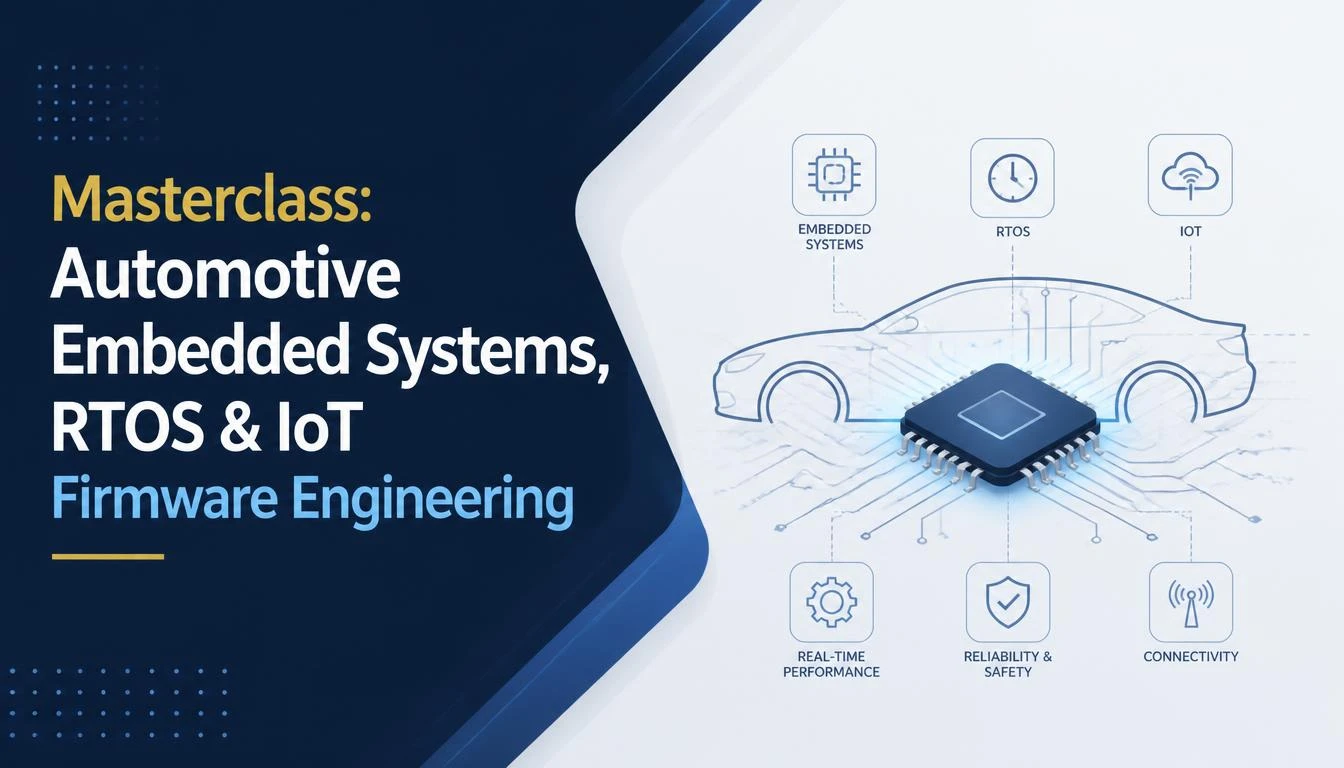
Masterclass: Automotive Embedded Systems, RTOS & IoT Firmware Engineering

Master automotive ECU architecture, FreeRTOS, CAN Bus, AUTOSAR, and MISRA-C on ARM Cortex-M hardware.
16 Weeks
Classroom Lab & Hybrid
English & Tamil
Enroll Now

Course Curriculum

1. Advanced Embedded C & ARM Cortex-M Architecture

  • Memory architecture: Flash, SRAM, Stack, Heap, and Memory Protection Unit (MPU)
  • Register-level programming: Volatile keyword, bit manipulation, bit-banding, and bitwise masks
  • Pointers deep-dive: Function pointers, callback architectures, and DMA memory buffers
  • MISRA-C:2012 compliance: Writing deterministic, safety-critical code free from undefined behaviors
  • ARM Cortex-M core: Exception handling, NVIC (Nested Vectored Interrupt Controller), and priority grouping

2. Bare-Metal Peripheral Driver Development from Scratch

  • GPIO driver development: Pin multiplexing, pull-up/pull-down modes, and external interrupt (EXTI) configuration
  • Hardware Timers & PWM: Generating deterministic frequency signals for motor control and pulse-width modulation
  • Communication interfaces: Writing robust, non-blocking drivers for USART, SPI, and I2C peripherals
  • Analog-to-Digital Conversion (ADC): Multi-channel scanning, continuous conversion, and thermistor sensor calibration
  • Direct Memory Access (DMA): High-throughput peripheral-to-memory and memory-to-memory data transfers without CPU overhead

3. Real-Time Operating Systems (RTOS) with FreeRTOS

  • RTOS fundamentals: Preemptive priority scheduling vs cooperative multi-tasking vs bare-metal super-loops
  • Task lifecycle, task creation (`xTaskCreate`), stack sizing, and context switching mechanics
  • Inter-Task Communication: Thread-safe Queues, Mailboxes, and Event Groups
  • Synchronization & Mutual Exclusion: Binary Semaphores, Counting Semaphores, and Mutexes with Priority Inheritance
  • Software Timers, Idle Task hooks, and memory allocation strategies (Heap_1 through Heap_5)

4. In-Vehicle Networking: CAN 2.0B, CAN-FD & LIN Protocols

  • CAN bus physical layer: Differential voltage signaling (CAN_H, CAN_L), termination resistors, and noise immunity
  • CAN frame format: Standard (11-bit) vs Extended (29-bit) IDs, RTR, DLC, CRC, and ACK fields
  • Non-destructive bitwise arbitration, bit stuffing rules, and fault confinement (Error Active, Error Passive, Bus-Off)
  • CAN-FD (Flexible Data-rate): Expanding payload capacity from 8 bytes to 64 bytes at speeds up to 5 Mbps
  • Hands-on bus capture: Sniffing, decoding, and injecting CAN packets using USB CAN transceivers and logic analyzers
  • LIN (Local Interconnect Network): Master-slave single-wire bus architecture for automotive body electronics

5. Automotive Diagnostics & Unified Diagnostic Services (UDS - ISO 14229)

  • Introduction to On-Board Diagnostics: OBD-II (ISO 15031) vs UDS (ISO 14229)
  • ISO-TP (ISO 15765-2): Transport protocol for multi-frame segmentation over CAN bus
  • Core UDS Services: Read Data By Identifier (0x22), Write Data (0x2E), and Diagnostic Session Control (0x10)
  • Diagnostic Trouble Codes (DTC): Read DTCs (0x19), Clear DTCs (0x14), and fault status mask reporting
  • Security Access (0x27): Seed-key authentication algorithms and security clearance levels
  • Implementing an embedded UDS Server stack on an ARM Cortex microcontroller

6. Classic AUTOSAR Architecture & ISO 26262 Functional Safety

  • Overview of AUTOSAR (Automotive Open System Architecture): Motivation, consortium standards, and layering
  • Microcontroller Abstraction Layer (MCAL): Hardware-dependent drivers (DIO, Port, CAN, SPI, ADC)
  • Basic Software (BSW): Communication stack (Com, PduR, CanIf), Memory stack (Fee, Ea, NvM), and OS
  • Runtime Environment (RTE): Abstracting communication between Software Components (SWCs) and BSW
  • ISO 26262 Functional Safety: Hazard Analysis and Risk Assessment (HARA) and ASIL levels (A, B, C, D)

7. Automotive IoT, Telematics & Cloud Connectivity

  • Telematics Control Unit (TCU) architecture: Integrating GPS/GNSS location data with vehicle sensor telemetry
  • Cellular Cat-M / 4G and WiFi connectivity using AT command drivers
  • Lightweight IoT messaging: MQTT and CoAP protocols with TLS 1.3 mutual certificate authentication
  • AWS IoT Core integration: Publishing real-time vehicle telemetry shadows and subscribing to remote command topics
  • Power management and low-power sleep modes for battery-powered automotive telematics nodes

8. Secure Over-The-Air (OTA) Bootloader Engineering & Capstone Defense

  • Bootloader fundamentals: Vector table relocation, memory partitioning, and application jump sequences
  • Dual-Bank Flash memory architecture: Live firmware flashing into Bank 2 while Bank 1 runs safely
  • Cryptographic binary verification: Validating incoming updates with SHA-256 hashes and digital signatures
  • Automatic rollback mechanisms: Safeguarding against corrupted firmware flashes and power interruptions
  • Capstone Project: End-to-End Electric Vehicle Battery Management System (BMS) with CAN Telemetry & Cloud Diagnostics

Take the Next Step in Your Career

Join our comprehensive Masterclass: Automotive Embedded Systems, RTOS & IoT Firmware Engineering program and gain real-world skills that employers demand.