

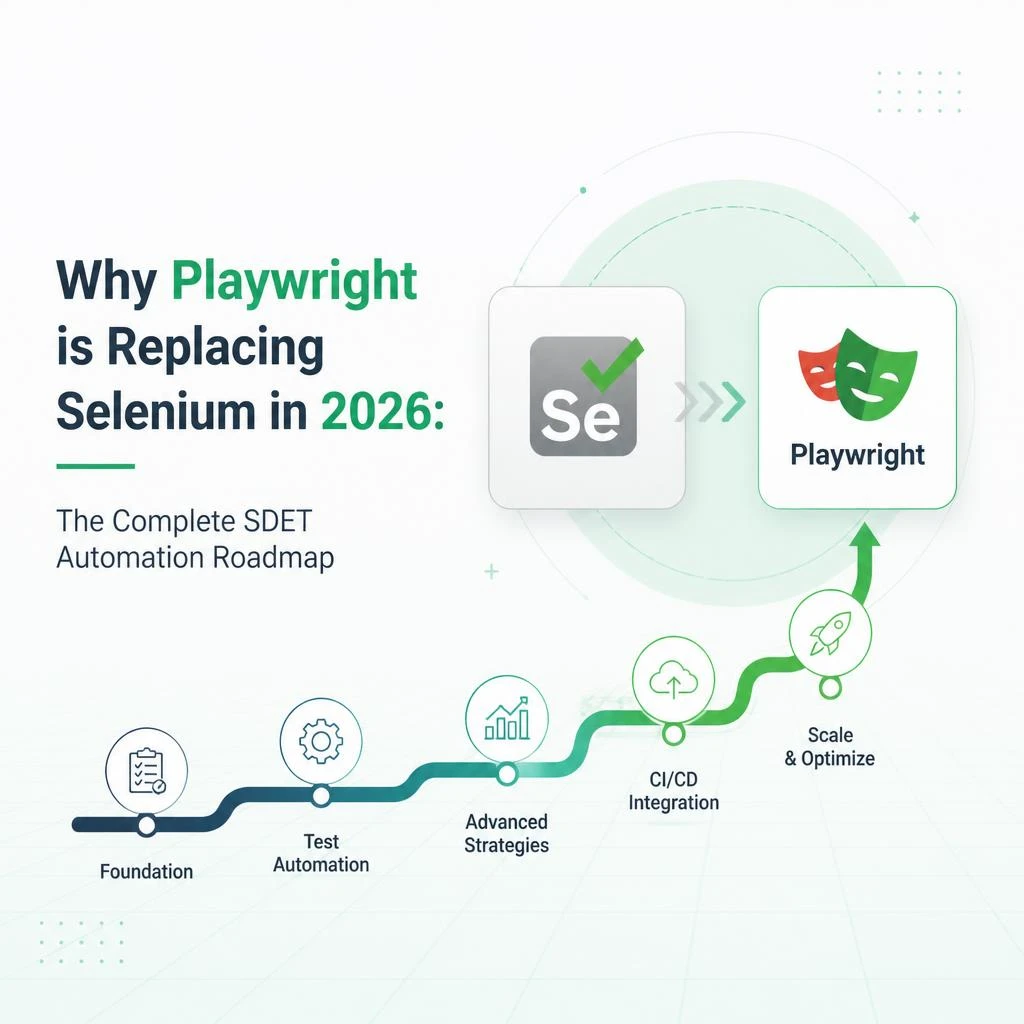
1. The Automation Crisis: Why Selenium is Dying in Modern Enterprise Stacks
To understand why Playwright is dominating 2026, one must first look at the core architectural bottlenecks of Selenium WebDriver.
Selenium operates over an HTTP request-response model. For every single user action—such as clicking a button or typing text—Selenium sends an HTTP request to an intermediary browser driver executable (chromedriver, geckodriver), which translates the command and forwards it to the browser. This HTTP round-trip introduces significant network latency.
More critically, modern frontend frameworks (React, Vue, Angular) render UI asynchronously. When a button appears in the DOM, it might not yet be clickable due to background JavaScript hydration or pending API calls. In Selenium, this triggers the infamous 'StaleElementReferenceException' or 'ElementNotInteractableException', forcing QA engineers to write messy, hardcoded Thread.sleep() delays or brittle explicit wait loops.
- HTTP Overhead: Multiple network hops per test step leading to slow execution suites.
- Driver Incompatibility Hell: Constant browser version mismatches requiring manual driver updates.
- The Flakiness Epidemic: False-positive test failures causing developers to ignore CI/CD alerts.
2. The Playwright Architectural Revolution: WebSockets & Auto-Waiting
Built by the original core team behind Puppeteer at Microsoft, Playwright was engineered from the ground up for modern, real-time web applications.
Instead of slow HTTP polling, Playwright establishes a single, continuous WebSocket connection directly to the browser's native debugging protocol (Chrome DevTools Protocol for Chromium, and native CDP equivalents for Firefox and WebKit). This enables bidirectional, zero-latency communication.
Playwright's killer feature is Auto-Waiting. Before executing any action (such as a click or keypress), Playwright automatically runs an internal actionability check: it verifies that the element is attached to the DOM, visible, stable (not animating), enabled, and not covered by other overlay elements. If these conditions are not met, it waits automatically until the configurable timeout expires, completely eradicating 95% of test flakiness.
- Direct WebSocket Connection: Blazing-fast bidirectional execution with zero intermediary drivers.
- Native Auto-Waiting: Automatically checks visibility, stability, and enablement before acting.
- Multi-Engine Parity: Native testing on Chromium (Chrome, Edge), Firefox, and WebKit (Safari) from a single API.
- Browser Context Isolation: Spins up pristine, isolated browser profiles in under 50 milliseconds.
3. Playwright vs. Cypress vs. Selenium: The 2026 Showdown
When modern engineering teams evaluate automated testing frameworks in 2026, the comparison invariably narrows to Playwright vs Cypress.
While Cypress was a beloved pioneer in modern testing, its in-browser execution model imposes severe architectural limits: Cypress runs inside an iframe inside the browser, making multi-tab workflows, multiple browser windows, cross-origin iframes, and multi-domain authentication exceedingly complex or impossible without workarounds.
Playwright has no such constraints. It operates out-of-process, controlling multiple browser windows, multi-tab communication, cross-origin redirects, and even testing mobile viewports simultaneously. Furthermore, Playwright supports TypeScript, JavaScript, Python, Java, and C#, whereas Cypress is strictly JavaScript/TypeScript.
- Multi-Tab & Multi-Window: Playwright handles native multi-tab scenarios flawlessly; Cypress struggles.
- Language Support: Playwright supports TypeScript, Python, C#, Java; Cypress supports JS/TS only.
- Parallel Execution: Playwright provides free, built-in multi-core parallel worker sharding without paid cloud tiers.
- Speed: Independent benchmarks demonstrate Playwright suites run 2x to 4x faster than Selenium and Cypress.
4. Beyond UI: Unified API Testing, Visual Regression & Trace Viewer
Playwright is no longer just a browser UI tester; it has evolved into a complete, unified quality engineering platform.
API Testing & Mocking: Using Playwright's built-in APIRequestContext, you can execute REST API queries, validate payloads, and inject authentication cookies directly into browser sessions. You can also intercept network requests (page.route()) to mock failing backend microservices or simulate slow 3G networks.
Visual Snapshot Testing: Playwright includes native pixel-by-pixel visual regression testing (expect(page).toHaveScreenshot()). It automatically detects unwanted CSS shifts, broken font rendering, and layout bugs across viewports.
Playwright Trace Viewer: When a test fails in headless CI/CD, Trace Viewer provides a full time-travel debugger containing DOM snapshots before and after every step, network requests, console logs, and action timings—allowing engineers to diagnose failures in seconds.
- Unified Test Stack: Execute UI E2E tests, REST API tests, and visual diffs in a single framework.
- Time-Travel Trace Viewer: Complete visual debugging recording of DOM states and network traffic.
- Network Mocking: Intercept and mock backend APIs on the fly without running mock servers.
5. The 2026 SDET Career Roadmap: From Manual QA to 12 LPA+ Engineer
The era of manual-only QA is coming to an end. Tech companies across Chennai (OMR, Guindy) and Coimbatore (Tidel Park, Saravanampatti) are aggressively upgrading QA teams to SDET (Software Development Engineer in Test) roles.
To transition successfully into a high-earning SDET in 2026, follow this structured roadmap:
Step 1: Master TypeScript Fundamentals. Learn strong typing, interfaces, async/await, and ES6 modules.
Step 2: Master Playwright Core. Learn locators (getByRole, getByTestId), web-first assertions, and custom test fixtures.
Step 3: Architect Page Object Model (POM). Design clean, modular, maintainable page classes with decoupled test data.
Step 4: Integrate REST API Automation. Validate backend endpoints and use API tokens to skip slow UI login screens.
Step 5: Master CI/CD & Reporting. Build GitHub Actions workflows that run parallel test shards on pull requests and generate Allure reports.
- Month 1-2: TypeScript / Python foundations and core Playwright locators.
- Month 3: Building robust Page Object Model (POM) frameworks and custom fixtures.
- Month 4: API test automation, network mocking, and visual regression.
- Month 5: CI/CD integration with GitHub Actions, Dockerized runners, and Allure reporting.
- Month 6: Capstone project, GitHub portfolio polish, and SDET mock interviews.
6. Launch Your SDET Career with Beetalogic in Coimbatore & Chennai
Beetalogic's Masterclass in Playwright Automation Engineering & Modern SDET in Coimbatore and Chennai is designed to transform fresh graduates and manual testers into industry-ready automation engineers.
Our students build complete, production-grade test frameworks for live SaaS applications, implement real-world API test suites, configure GitHub Actions CI/CD pipelines, and master time-travel debugging.
With dedicated 1-on-1 mentor guidance, hands-on labs, and 100% placement support with top product and IT service companies across Tamil Nadu, Beetalogic is your gateway to a lucrative SDET career.
- 100% Hands-On Labs: Build 2 production-grade automation frameworks from scratch.
- Comprehensive Curriculum: Covers Playwright, TypeScript, Python, REST APIs, CI/CD, and Allure.
- Direct Placement Referrals: Regular interview drives with leading tech enterprises in South India.
Explore Local IT Training Programs
Top-rated job-oriented training & internships in Coimbatore & Chennai